
Your entryway is your home’s handshake. Your mudroom is its bouncer. One says, “Welcome in!”
The other says, “Absolutely not, muddy shoes.” If your current setup feels more like a
lost-and-found bin exploded by the front door, don’t worrythis is one of the easiest spaces
to improve because small changes (hooks! benches! a rug that can survive reality!) create
instant wins.
Below are practical, design-forward entryway and mudroom ideasorganized like a good drop zone:
everything has a place, and nothing is allowed to “just live on the floor.” We’ll cover layout,
storage, style, lighting, materials, and real-life examples so you can build a space that looks
good and works even on rainy Mondays.
Start With the “Traffic Report”: Layout That Actually Works
1) Map the daily flow (then stop fighting it)
Before you buy anything, watch how people enter your home for two days. Where do shoes land?
Where do backpacks get tossed? Which door is the real “main entrance” (even if you wish guests
used the front door)? Great entryways aren’t perfectthey’re honest. Design around your habits
instead of trying to train everyone with your mind.
2) Protect the walkway
Keep a comfortable path so the space doesn’t feel like an obstacle course. If your entry is
narrow, skip bulky furniture and use wall-mounted storage: a slim shelf, hooks, and a mirror
can do more than a chunky console that turns every arrival into a sideways shuffle.
3) Create zones in this order
- Landing zone: keys, wallet, mail, sunglasses (small items that vanish).
- Shoe zone: where footwear gets removed and contained (ideally off the floor).
- Hang zone: coats, bags, hats, dog leash, umbrellas.
- Clean-up zone (mudrooms): boot tray, towel hooks, maybe a utility sink if you’re fancy.
Storage That Looks Intentional (Not Like You’ve Given Up)
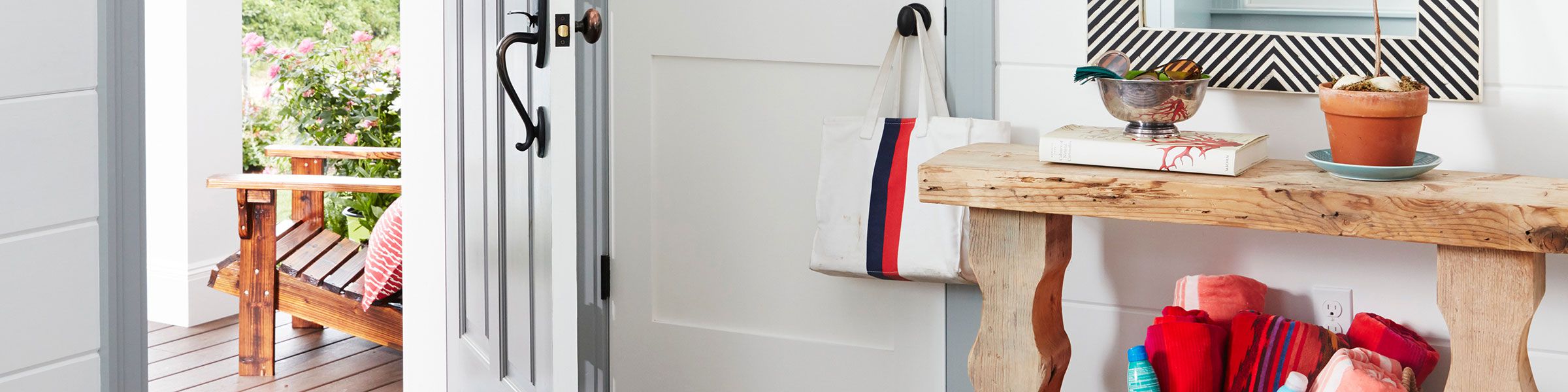
1) The bench: the MVP of entryways and mudrooms
A bench gives you a place to sit while putting on shoes and creates an obvious “drop” spot that
isn’t your dining chair. For high-traffic homes, a bench with cubbies or drawers underneath is
a game-changer: shoes go in, clutter disappears, sanity returns.
- Small space tip: choose a narrower bench or a wall-mounted floating bench to keep the floor visually open.
- Real-life win: add a couple of baskets under the bench for gloves, hats, and pet gear.
2) Hooks beat hangers for everyday life
Closets are great, but hooks are fasterespecially for kids. Use a mix of hook heights so
everyone can reach. If you want it to feel designer (not summer camp), pick matching hardware
and line hooks evenly. Bonus: hooks reduce the “I’ll hang it later” pile because later never
shows up.
3) Mix open and closed storage for a clean look
Open storage is convenient but can look messy fast. Closed storage hides the chaos. The sweet
spot is a mix:
- Open: hooks for daily coats, a tray for keys, a small basket for dog leashes.
- Closed: a cabinet or console with doors for random items, extra sunscreen, backup umbrellas, and the mail you swear you’ll sort.
4) “Drop zone” details that prevent clutter creep
The best drop zones are tiny but strict. Try these:
- Key tray or bowl: one spot, always the same spot.
- Mail sorter: a wall file or narrow organizer so paper doesn’t sprawl.
- Charging station: a drawer or shelf with a power strip so devices don’t colonize your kitchen counter.
- Labeling: subtle labels on baskets or bins for each person (it’s harder to argue with a bin that has your name on it).
Materials That Can Survive Weather, Kids, and Actual Life
1) Flooring: choose “forgives dirt” over “shows every speck”
Your entryway is a dirt checkpoint. Durable, easy-clean floors make the whole home easier to
maintain. Many mudrooms and busy entryways do well with tile, luxury vinyl plank, sealed
concrete, or other water-friendly surfaces. If you love wood, consider a tough finish and a
great rug system so it doesn’t take daily damage.
2) Rugs: two layers, one purposetrap the mess
A washable runner or indoor/outdoor rug is your best friend. In wet climates, a larger rug
catches more grit (and prevents the “mud footprints modern art installation” effect). In snowy
areas, add a boot tray near the door so slush stays contained.
3) Paint and wall finishes: make cleanup easy
Entryway walls get scuffed by bags, elbows, and the occasional runaway backpack. Washable paint
finishes help. Want extra protection? Consider paneling, beadboard, board-and-batten, or a
wainscot that handles bumps without looking battered.
Design Ideas That Make a Great First Impression
1) Mirrors: style + function + “Do I have spinach in my teeth?”
A mirror brightens the space, reflects light, and makes small entryways feel larger. It also
provides that last-second outfit check before you walk out the door. If your entry is dim,
mirrors do double duty: decor and visual expansion.
2) Lighting: don’t let your entryway feel like a cave
Good lighting is the quiet hero of an entry. If you have a ceiling fixture, consider a flush
mount or semi-flush light that feels intentional. In larger spaces, a pendant can create a
focal point. For mudrooms with built-ins, under-shelf lighting or a small sconce can make the
area feel polishednot purely utilitarian.
3) Console tables (when you have the space)
A console table can anchor an entryway and offer storage. The trick is keeping it useful, not
decorative clutter. Choose one with drawers or a lower shelf. Style it with a lamp (or a small
light), a tray for essentials, and one visual statementlike art or a tall vase.
4) Wall decor that works hard
- Gallery wall: keeps attention up and away from the shoe zone.
- One large art piece: calmer than many small frames in tight spaces.
- Chalkboard/whiteboard: great for reminders (and can replace the “sticky note wallpaper” phenomenon).
Mudroom Design Moves That Make Mornings Easier
1) Built-ins and “locker” setups for families
If you have the space (even a small wall), built-ins can create a mudroom that runs like a
system: cubbies below, bench in the middle, hooks above, shelf up top. This structure makes
it easy to assign each person a spot. Less arguing. Fewer missing shoes. More leaving the house
on time (or at least less chaos while being late).
2) Add a towel hook and a “wet stuff” plan
Mudrooms shine when they handle the messy moments: wet coats, damp gloves, muddy dog paws.
Consider a dedicated towel hook, a basket for wet gear, and a boot tray. If you’re renovating,
a floor that tolerates water and a setup that allows quick drying are big quality-of-life upgrades.
3) Include pet-friendly features
If your dog uses the door like it’s a revolving restaurant, add a leash hook, treat jar (with a
lidbecause dogs are brilliant), and a basket for toys. In mud-prone areas, keep paw wipes or a
towel within reach so you can clean up before the living room becomes the “after” photo.
Small Entryway and “No-Real-Mudroom” Solutions
1) Turn a closet into a mini mudroom
A coat closet can become an organized drop zone with a few upgrades: double hanging rods, hooks
on the inside of doors, a shoe shelf at the bottom, and bins up top. If the closet is shallow,
consider a slim shoe cabinet elsewhere so footwear doesn’t pile up in a dramatic heap.
2) Use vertical space like you mean it
Narrow spaces benefit from wall storage: floating shelves, peg rails, wall-mounted cubbies, and
hooks. A slim shelf can hold keys and mail without stealing walking space. Add a mirror above it
and you’ve basically created a functional entryway on a diet (in the best way).
3) Choose pieces that “hide” visually
In tight entryways, lighter colors, open legs (instead of bulky bases), and wall-mounted pieces
keep the area airy. If you need shoe storage, consider a closed cabinet so the visual noise of
footwear doesn’t dominate the entire first impression of your home.
Style Ideas by Vibe (So It Matches the Rest of Your Home)
Modern
- Simple bench, minimal hooks, one bold mirror, a streamlined runner.
- Black or brushed metal hardware for a crisp look.
Modern farmhouse
- Wood bench, woven baskets, paneled wall treatment, warm lighting.
- Neutral palette with a durable patterned rug to hide dirt.
Coastal
- Light woods, airy colors, jute or seagrass accents, relaxed art.
- Easy-clean floors for sand and wet swim gear.
Traditional
- A console table with drawers, classic lamp, framed art, and a tailored runner.
- Symmetry helps this style feel composed and welcoming.
Budget-Friendly Upgrades With Big Impact
- Swap hardware: matching hooks and pulls instantly looks “custom.”
- Add a washable runner: protects floors and makes the space feel finished.
- Install a shelf + hooks: a weekend project that creates structure fast.
- Use baskets: affordable, flexible, and great for hiding the random stuff.
- Paint: one coat can transform a bland entryway into a designed moment.
Common Mistakes (and How to Avoid Them)
1) Too much furniture
An entryway is not a showroom. If it blocks the path, it’s not helping. Choose fewer pieces
that do more: a bench with storage beats a bench plus a table plus a chair plus a decorative
ladder you have to dodge like a video game.
2) No container for shoes
Shoes are the mess multiplier. Even a simple rack or a couple of bins helps. If your household
keeps shoes on, a mat and a designated spot still reduce dirt traveling into the home.
3) A drop zone with no rules
The secret to a tidy entryway isn’t perfectionit’s boundaries. Decide what belongs there
(keys, daily bags, shoes in rotation) and what doesn’t (every piece of mail from 2019).
Extra : Real-Life “Experience” Lessons From Entryways and Mudrooms
Here’s the part most inspiration photos don’t show: the Monday morning sprint, the rainy-day
chaos, the “where is my other shoe?” mystery, and the dog who believes mud is a skincare
routine. In real homes, the most successful entryways and mudrooms tend to share a few
experience-tested truths.
First, people rarely maintain systems that require extra steps. If coats must be placed on
hangers inside a closet behind a door, many coats will eventually end up on the nearest chair.
Hooks win because they’re fast. When families add two hook heightsone for adults and one for
kidsthere’s a noticeable drop in clutter because kids can actually participate without asking
for help. The same goes for shoes: an open cubby or rack near the door gets used far more than
a “perfect” storage method that’s inconvenient.
Second, the best entryways plan for the mess instead of acting surprised by it. A boot tray
sounds boring until you’ve seen slush drip across hardwood floors. A washable runner seems like
a small detail until it saves you from constant mopping. In wet climates, households often keep
a small basket of “wet tools” by the dooran old towel, a microfiber cloth, paw wipes, and a
lint rollerbecause the fastest cleanup is the one you can do immediately.
Third, the “drop zone” needs a little personality or it becomes a dumping ground. One household
might add a framed photo wall above the bench so the area feels like a designed space, not a
utility corner. Another might place a small lamp on a console to warm up the entry and make it
feel welcoming at night. This matters because when an area feels intentional, people are more
likely to reset it. It’s weird, but true: a pretty bowl for keys is more likely to be used than
a random spot on the counter.
Fourth, small-space entryways work best when they go vertical and stay visually calm. In tiny
apartments, a wall shelf paired with a mirror can replace a bulky table, and a slim shoe cabinet
can keep footwear from taking over the floor. Many people find that closed storage is the
difference between “cozy” and “constant clutter,” especially when the entry opens directly into
the living room.
Finally, real life changes seasonallyso your entryway should, too. In summer, the system might
need space for hats, sunscreen, and reusable bags. In winter, it’s gloves, scarves, and taller
boots. The easiest long-term strategy is rotating what lives in the prime “grab zone” and moving
off-season items to higher shelves or a nearby closet. Think of it as seasonal staffing: the
front line should only hold what’s currently on duty.
Conclusion
Great entryway and mudroom design is a blend of function and first impression: clear zones,
easy storage, durable materials, and a few style moves that make the space feel welcoming.
Start by controlling shoes, add hooks and a bench, and build a simple drop zone you’ll actually
use. Once the “life stuff” is handled, decorating becomes the fun partbecause you’re styling a
space, not hiding a mess.