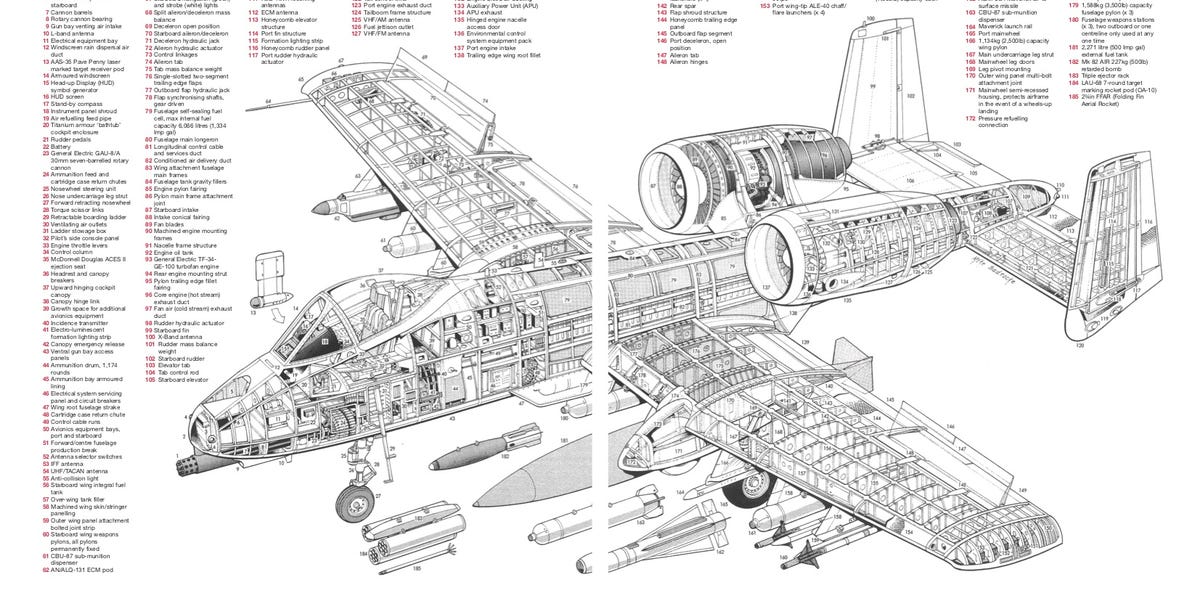

There are two kinds of people in the world: those who see a legendary aircraft and say, “Cool plane,” and those who see
the same aircraft and immediately want to read 900 pages about its hydraulic systems, cockpit switches, and the exact
torque spec for a panel fastener that nobody notices unless it’s missing. If you’re here, congratulationsyou’re in the
second group. And honestly? That’s where the fun is.
The A-10 Thunderbolt IInicknamed the “Warthog” and sometimes lovingly shortened to “Hog”has earned a fanbase that’s
part aviation nerd, part history buff, and part “tell me everything about how this machine survives the worst day at work.”
It’s widely described as the first U.S. Air Force aircraft designed specifically for close air supportthat
gritty, complicated mission of protecting ground forces in the messy part of the map. The A-10’s reputation is wrapped up
in straightforward design choices: durability, maintainability, and the ability to keep doing the job in rough conditions.
Which is exactly why its documentation culture is so fascinating.
This article isn’t a “how-to-operate-an-aircraft” guide (please don’t). Instead, it’s a guided tour of what makes an
exhaustively detailed A-10 manual so compellinghow technical aviation documents are structured, what kinds of information
enthusiasts can learn from publicly available materials, and what the A-10 story reveals about engineering that’s designed
for reality, not runway glamour shots.
Why the A-10 Sparks “Manual Curiosity” Like Few Other Aircraft
Some aircraft are icons because they’re sleek. The A-10 is iconic because it looks like it showed up to the office in steel-toe
boots, carrying a toolbox and a “let’s get it done” attitude. According to U.S. Air Force and museum fact sheets, the A-10
was built around the close air support mission and optimized for low-altitude, low-speed maneuveringan environment where
survivability and accuracy matter a lot. That mission focus is the root of the “manual obsession”: the A-10 isn’t mysterious.
It’s knowable. It invites documentation.
And then there’s the aircraft’s public persona. The Warthog is famous for its internal 30 mm cannon and the way the aircraft
was engineered to keep flying after taking damage. Even if you never go near a flightline, the A-10’s story naturally leads
to questions like: How is it built? How does it protect the pilot? How do maintainers keep it mission-ready? What changed
when it became the A-10C? Those are “manual questions.”
What Counts as an “A-10 Manual,” Anyway?
In Air Force-world, “manual” can mean multiple thingspilot references, maintenance instructions, system descriptions, and
the broader family of documents often grouped under the term Technical Orders (TOs). Think of TOs as the
structured, controlled “source of truth” for operating and maintaining complex systems. They don’t exist to entertain you
(though they absolutely can). They exist to keep people safe, equipment reliable, and procedures standardized.
Here’s the key point for enthusiasts: some Technical Orders are approved for public release, while others are
restricted for safety and security reasons. Public-release TO libraries typically include clear distribution statements and
disclaimers about currency and proper use. So, yes, there’s a legitimate lane for curious readersbut it’s a lane with guardrails.
Your job as a reader is to stay in it.
The “Big Buckets” You’ll See in Highly Detailed Aviation Documentation
Without getting into step-by-step operational instructions, most exhaustive aviation documentation tends to organize information
into buckets like these:
- Aircraft overview and mission context: what the platform is designed to do and why it’s built the way it is.
- Systems descriptions: electrical, fuel, hydraulics, flight controls, landing gear, avionics, and more.
- Limitations and cautions: the hard lines you don’t cross, plus the reasons behind them.
- Inspection and maintenance philosophy: scheduled checks, troubleshooting logic, and common wear points.
- Configuration and upgrades: how modernization changes capabilities and maintenance demands over time.
For a plane like the A-10, those sections read like a biography written in engineering. They tell you what the aircraft “believes”
about the world: that it might operate from forward locations, that it must be serviceable, that redundancy matters, and that
survivability isn’t a buzzwordit’s a design requirement.
Meet the A-10’s Core Design Story: Simple, Survivable, Serviceable
The U.S. Air Force describes the A-10C as a simple, effective, survivable twin-engine jet designed for close air support. The
museum framing echoes that mission-first identity, emphasizing low-speed/low-altitude maneuverability and the armor and systems
needed to survive in that environment. Those ideas show up everywhere in the way people talk about the A-10and they’re the
reason the “manual” feels so unusually readable.
Performance, in Plain English
If you skim an A-10 overview page, you’ll usually find performance figures such as top speed, ceiling, and range. These numbers
help explain why the aircraft’s mission is what it is: it’s not trying to be a high-speed interceptor. It’s built to show up,
stay on station, and work with ground forces. Many aviation references summarize its performance in a way that’s accessible to
general readers, giving you a “spec sheet” baseline before you dive deeper.
Survivability That Reads Like a Checklist of “Bad Day Planning”
The A-10’s reputation for survivability is one of the main reasons people want to read its documentation. The aircraft is often
described as having armor protection for the cockpit and key systems, plus redundancy in critical components. In enthusiast terms,
it’s the aircraft equivalent of: “I brought snacks, water, a backup charger, a second backup charger, and a small engineering team.”
What makes this documentation interesting (from a safe, public perspective) is the why. Redundancy isn’t just bragging;
it’s a response to the environment the A-10 was built to operate in. The manual mindset is basically: assume things will go wrong,
then design and document how the platform keeps working.
A-10C: When the Manual Gets a Plot Twist
The original A-10 story is already compelling. Then modernization arrives and the documentation starts wearing a new outfit.
The A-10C upgrade, often described through the lens of the Precision Engagement program, added modern avionics and improved
situational awarenesschanges that matter for how pilots interface with the aircraft and how maintainers support it.
Public Air Force news releases have described this modernization as a major transformation, integrating upgraded systems and
improving communication and targeting capabilities. In other words: the “manual” evolves because the aircraft evolves, and the
A-10C becomes a case study in how platforms are updated without losing their original purpose.
Why Upgrades Make Documentation Even More Addictive
If you’ve ever watched a software app get a new user interface, you already understand the A-10C documentation vibe. Upgrades
introduce new displays, new workflows, new terms, and new troubleshooting pathways. Good documentation becomes the translator
between “what this aircraft used to be” and “what it is now.” That’s catnip for detail-lovers, because it shows the continuity
of design logic across decades.
The Manual’s “Hidden Main Character”: Maintenance Culture
For many aircraft fans, the most interesting parts of an exhaustive manual aren’t glamorous at all. They’re about upkeep.
Maintenance documentation is where you see the aircraft’s real personality: which parts are designed for access, what gets inspected
frequently, what components are considered critical, and how reliability is protected.
The A-10’s reputation for ruggedness naturally pulls attention toward maintainability. The aircraft’s story is inseparable from
the people who keep it operationalbecause the A-10 isn’t a “museum-only” legend. It’s a working platform that has undergone upgrades,
faced retirement debates, and continued to play roles in U.S. Air Force planning discussions.
Why the “Retirement Debate” Shows Up in the Way People Read Manuals
Over the years, proposed divestment and replacement discussions have appeared in government analyses and public reporting. Those
conversations often revolve around budgets, mission needs, and changing threat environmentsbig-picture issues that aren’t in a
technical manual. But they influence what people want to know: what makes the A-10 unique, what capabilities are hard to replicate,
and why modernization decisions matter.
If you’re reading with a historian’s eye, public reports can give context: the A-10 isn’t just an aircraft, it’s a long-running
argument about close air support, force structure, and how militaries balance specialized tools with multi-role platforms.
(In other words: the A-10 is a plane and also a never-ending group chat.)
How to Enjoy “Manual-Level Detail” Safely and Responsibly
Here’s the responsible-reader checklistbecause “I love details” and “I respect safety and legal boundaries” can absolutely be friends:
- Stick to public-release materials: Museums, official fact sheets, and publicly cleared Technical Orders are the safe lane.
- Use manuals as context, not instructions: Read for engineering appreciation, history, and systems literacynot for operation.
- Prefer analysis and interpretation: The “why it’s designed this way” story is the most interesting part anyway.
- Lean on reputable sources: Official Air Force pages, government accountability reports, and major publications beat rumor threads every time.
If you want the “exhaustively detailed manual” feeling without drifting into content that shouldn’t be shared or used, the best
approach is to build a reading stack: official fact sheets for a baseline, museum overviews for historical framing, and public
government reports for policy context. That combination gives you the satisfying density of a manualwithout crossing lines that
exist for good reasons.
What You Can Learn from the A-10 Without Turning It into a How-To
1) Engineering for the mission beats engineering for the brochure
The A-10’s story is a reminder that “best” depends on the job. The aircraft is repeatedly described in official and museum sources
as purpose-built for close air support, and its design choices reflect that specialization. Manuals make this obvious: they don’t
spend time pretending the A-10 is something it isn’t. They document what it must do reliably.
2) Modernization is a documentation challenge as much as a hardware challenge
A-10C upgrades weren’t just “new gear.” They changed how pilots interact with the aircraft and how maintainers manage systems.
Public Air Force communications about the modernization emphasize improved situational awareness and updated capabilitiesexactly
the kind of change that forces documentation to become sharper, clearer, and more integrated.
3) Good documentation is a safety system
The most underappreciated truth about aviation manuals is that they are a safety technology. They standardize actions, reduce ambiguity,
and help teams communicate across shifts and locations. Even if you never touch a wrench or step into a cockpit, reading manuals
(the public parts) is a way to understand how serious organizations reduce risk.
Final : The “Experience” of Going Full A-10 Manual Mode
Let’s talk about the lived experience of being the kind of person who gets excited about an “exhaustively detailed manual” for a legendary
aircraft. Not the experience of operating anything (nope), but the experience of learning like a fan with a librarian’s heart.
It often starts innocently: you see an A-10 in a museum, or you catch a video clip of that unmistakable silhouette, and you think,
“I should probably learn the basics.” So you read an official fact sheet. Next thing you know, you’re comparing the language in a museum
exhibit description to the way an aviation publication summarizes performance. You notice how different sources emphasize different “characters”
in the A-10 story: one highlights mission and survivability; another leans into modernization; another frames the aircraft in the broader debate
about close air support and force structure.
Then comes the “manual brain” momentwhen you realize your favorite part isn’t the headline fact. It’s the structure. You start appreciating how
technical documentation organizes reality: systems, limitations, cautions, and the logic that ties them together. You begin to notice phrases like
“distribution statement” and understand why it matters. You learn that some documents are public-release and meant to be shared widely, while others
are restricted for safety and security. Suddenly, your curiosity gets a grown-up upgrade: it’s not just what you want to know, it’s
how knowledge is controlled, verified, and safely communicated.
The experience is surprisingly comforting. In a world full of hot takes, a technical document is refreshingly unbothered. It doesn’t care about hype.
It cares about clarity. It cares about repeatability. It cares about “if X happens, this is the system behavior,” and “here is how this component is
identified,” and “here is the standard language we use so nobody misunderstands.” That tone can feel almost therapeuticlike listening to someone who
actually read the instructions before assembling the bookshelf.
And when you zoom out, you realize “A-10 manual mode” is bigger than one aircraft. It’s a way of learning: patient, structured, evidence-based, and
respectful of boundaries. You can chase details through public sourcesfact sheets, museum write-ups, government reports, and reputable aviation
journalismuntil you’ve built a rich mental model of what the A-10 is and why it has the reputation it does. You get specific without getting reckless.
You get curious without getting careless.
The best part? That curiosity transfers. Once you’ve learned to read technical material for meaning, you start spotting the same patterns everywhere:
redundancy as a philosophy, documentation as a safety system, and upgrades as a story of translation between eras. The A-10 just happens to be a perfect
teacherbecause it was built to be understood, supported, and kept working in the real world. And if that isn’t the most “manual-worthy” personality
a machine can have, what is?