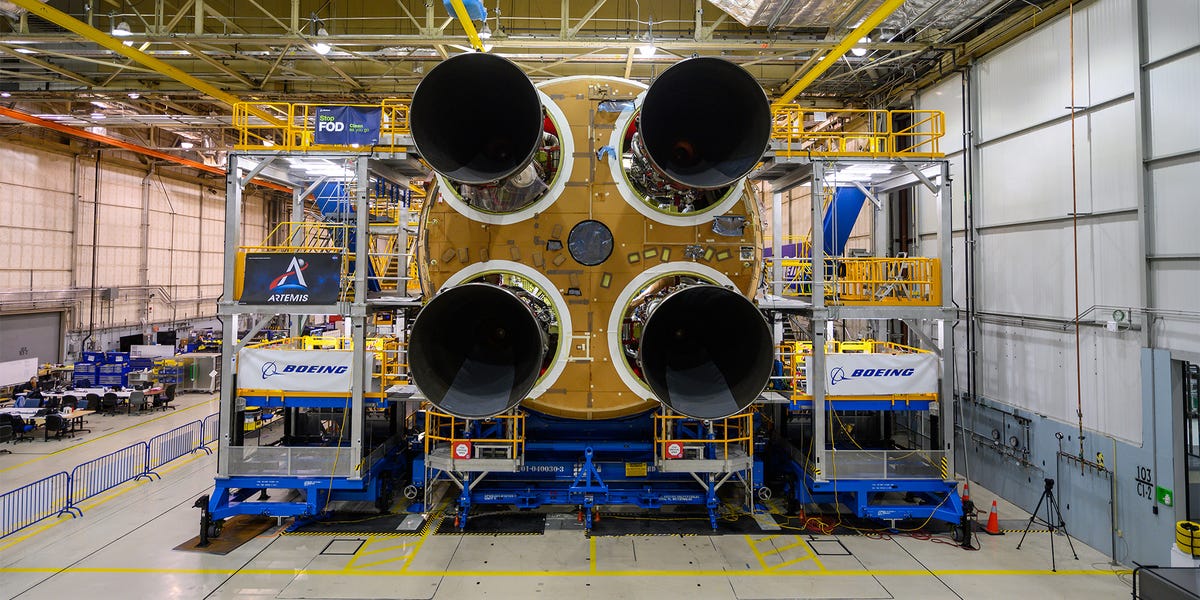

Short version: the RS-25 can absolutely help launch us toward Marsbut it won’t do the interplanetary “road trip” part. Think of it like the world’s most sophisticated, hydrogen-powered slingshot: it can hurl a lot of mass off Earth, fast, with incredible precision. After that, the Mars-bound vehicle needs a very different set of engines (and a whole lot of planning, propellant, and patience).
Still, the question is worth asking because the RS-25 has a résumé that’s hard to beat. It spent decades as the Space Shuttle Main Engine (SSME), became one of the most tested large rocket engines ever built, then “retired”… only to be called back for one more tournow powering NASA’s Space Launch System (SLS). If you ever wanted a comeback story with turbopumps, this is it.
Meet the RS-25: the shuttle’s brainy, brawny main engine
The RS-25 is a liquid oxygen/liquid hydrogen (LOX/LH2) engine that uses a high-performance staged-combustion cycle. Translation: it squeezes more efficiency out of its propellants than many other chemical rocket engines, which matters a lot when you’re trying to throw giant payloads out of Earth’s gravity well without also throwing away the national budget.
Why engineers love it (and why it’s not “just another rocket engine”)
- High efficiency: LOX/LH2 engines can achieve very high specific impulse compared with kerosene engines, making them ideal for big lift where every extra second of efficiency counts.
- Deep throttling: The RS-25 can throttle to manage loads during ascenthandy when your rocket is basically a controlled explosion with a timetable.
- Decades of refinement: The engine evolved through upgrades in reliability, safety, and maintainability during the Shuttle era, then received modernization for SLS needs.
On the Shuttle, RS-25s were designed for reuse. That meant post-flight inspections, refurbishment, and a lot of careful attention to parts that had just endured a small eternity inside a combustion chamber. With SLS, the plot twists: the RS-25 still performs like a reusable enginebut it’s used on an expendable rocket.
So… how is a “retired” engine still working?
NASA didn’t pull the RS-25 out of storage because it was feeling nostalgic. The decision was largely practical: the U.S. already had flight-proven engines, test infrastructure, and deep institutional knowledge. For a heavy-lift rocket intended to carry crew and major deep-space payloads, “proven” is not a bad personality trait.
RS-25 on SLS: same heritage, new demands
SLS uses four RS-25 engines on its core stage. For SLS missions, the engines operate at higher performance targets than typical Shuttle flight operations, with SLS requiring roughly 512,000 pounds of vacuum thrust per engine at 109% rated power for the core stage configuration. That’s a polite way of saying NASA asked the RS-25 to hit the gym againthen run uphill while carrying a refrigerator.
The engines were also updated for SLS realities: modern controllers, new thermal environments (the core stage sits next to massive solid rocket boosters), and an operational model focused on manufacturing and integration efficiency rather than refurbishment for reuse.
What “taking us to Mars” really means
When people say “take us to Mars,” they often picture a single rocket launching directly to the Red Planet like it’s a nonstop flight. Real Mars missions are more like building a small traveling city in space, step by step, then sending it off on a months-long cruisewhile keeping humans alive, sane, and not too mad about the food.
The Mars mission stack has stagesliterally and figuratively
- Earth launch: Get heavy payloads to orbit or on a high-energy departure trajectory.
- In-space propulsion: Push the spacecraft from Earth vicinity to Mars and potentially back.
- Mars entry, descent, landing (EDL): The “please don’t become a crater” phase.
- Surface operations: Habitats, power systems, rovers, science, and a return vehicle.
- Return to Earth: Because even brave astronauts eventually miss fresh fruit.
The RS-25 lives almost entirely in Step 1. It burns for minutes, not months. It doesn’t do cruise. It doesn’t brake into Mars orbit. It doesn’t land. Butand this is a big “but”it can be a powerful enabler because Mars missions need lots of mass delivered to the right place with high reliability.
Where the RS-25 shines for Mars ambitions
1) Heavy-lift muscle for big, awkward cargo
Mars hardware is not minimalist. Even “lean” architectures need large volumes and masses: deep-space habitats, radiation shielding, life support, power systems, and landers big enough to deliver meaningful payloads to the surface. If you want fewer launches, you need more lift per launchand that’s exactly the niche RS-25 helps SLS fill.
2) Reliability as a strategy, not a slogan
For crewed missions, reliability isn’t just comfortingit’s mission architecture. If your plan requires a tight launch cadence and multiple critical rendezvous events, a reliable heavy-lift launcher reduces risk in a very unsexy but extremely important way: fewer surprise failures, fewer redesign spirals, fewer “we need a new plan” meetings at 2 a.m.
3) Artemis as a dress rehearsal for deep space
Even if Artemis is “Moon first,” it helps retire risks that matter for Mars: long-duration deep-space operations, radiation environments outside Earth’s protective bubble, life-support lessons, and large-scale mission integration. SLS/Orion missions aren’t Mars missionsbut they can be a training ground for systems and teams that may eventually support Mars.
Where the RS-25 does not solve the Mars problem
It’s a launch engine, not an interplanetary engine
Once you’re in space, the propulsion needs change. Chemical engines like the RS-25 are incredible at producing huge thrust for liftoff. But interplanetary travel often rewards different traits: high efficiency over long durations, restartability, refueling strategies, and sometimes entirely different propulsion categories (high-power solar electric, nuclear thermal, or advanced chemical stages optimized for deep space).
Expendable use is… emotionally complicated
The RS-25 was originally designed with reuse in mind. Using it on an expendable rocket is like buying a luxury espresso machine and using it once to make a single cup, then tossing it into the ocean. (Space is full of irony.) For Artemis I, for example, the RS-25 engines are not recovered after flight because recovery would impose major performance and design penalties.
Cost and production rate become the mission’s metronome
Mars missions likely require multiple heavy launchescargo pre-deployments, habitat elements, propulsion stages, and crewed vehicles. If each launch is extremely expensive and the launch rate is low, mission architecture gets constrained. NASA and its contractors have been working on reducing RS-25 production costs with modernization, but the RS-25 remains a complex high-performance engine with specialized manufacturing requirements.
Hydrogen is amazingand also a diva
Liquid hydrogen delivers top-tier performance, but it demands cryogenic handling, insulation, and careful operations. On the ground, it can be operationally challenging. In space, long-duration hydrogen storage introduces boil-off and thermal management complexities unless you invest in robust cryogenic fluid management technologies. For Mars architectures featuring long loiter times or in-space assembly, those challenges matter.
Could an RS-25-based strategy still support Mars?
Yeswith the right expectations. If “take us to Mars” means “provide a reliable heavy-lift launch capability for Mars mission components,” then the RS-25 (as part of SLS) can be part of a Mars pathway.
But if “take us to Mars” means “be the primary propulsion for Earth-to-Mars transit,” then no: the RS-25 isn’t designed for that job. It is an Earth launch engine built for high-thrust ascent and tightly controlled performance over a short burn, not for deep-space cruising.
A realistic Mars-flavored scenario where RS-25 matters
Imagine a Mars mission architecture that looks like this:
- Launch 1–2: Cargo landers and surface infrastructure (power systems, habitats, supplies) sent ahead.
- Launch 3: A deep-space transit habitat and life support spares sent to orbit for assembly.
- Launch 4: A propulsion stage or tug optimized for deep space (not RS-25) launched and integrated.
- Launch 5: Crew vehicle launched, rendezvous, depart for Mars at an optimal window.
In that scenario, RS-25 engines aren’t the starship captainthey’re the freight elevator that gets the heavy, awkward, mission-critical hardware where it needs to be so the real interplanetary vehicle can be assembled and fueled.
What would need to happen for RS-25 to be “more Mars-relevant”?
1) Sustainable cadence
Any Mars plan that leans on SLS needs a sustainable schedule: predictable production, predictable integration, and predictable launch operations. Mars windows open about every 26 months, and architectures often want cargo launched ahead of crew. If you can’t reliably hit windows with sufficient payload mass, the whole plan becomes a game of calendar Jenga.
2) Cost control that actually scales
Mars is expensive. The only way it becomes “repeatable” is if key systems become more affordable to fly repeatedly. NASA oversight reports have pointed out how large a share of SLS cost is tied to boosters and RS-25-related contracts, which is why cost-reduction targets and contracting changes matter for long-term sustainability.
3) A strong in-space propulsion partner
Even if RS-25 launches the pieces, you still need a robust strategy for moving and managing those pieces in space: propulsion, power, thermal control, and refueling. If you want Mars to be more than a one-time flag-and-footprints event, the center of gravity shifts toward in-space systems.
Bottom line: RS-25 can help start the Mars journey, but it won’t finish it
The RS-25 is one of the most capable chemical rocket engines ever flownhigh efficiency, deep throttling, and a heritage that earned its reputation the hard way: through decades of hot-fire tests and operational experience. As part of SLS, it can loft big payloads that might otherwise take many more launches to assemble.
But Mars is not a “single engine” problem. It’s an “entire transportation ecosystem” problem: launch, assembly, propulsion, life support, landing, surface power, and return. The RS-25 can be the opening actspectacular, loud, and extremely competentwhile the rest of the Mars story depends on what comes after MECO.
Experience Add-On: What decades of RS-25 lessons feel like in the real world (and why that matters for Mars)
When people talk about the RS-25, it’s easy to get hypnotized by the numbersthrust, efficiency, power level, seconds of burn time. But the more interesting “experience” is what the engine has taught NASA and industry about how to run a high-performance propulsion program without learning every lesson the hard way on launch day.
First experience: testing is a culture, not a checkbox. The RS-25 world is built around the idea that you don’t argue with physicsyou interrogate it. That means repeated hot-fire tests, deep instrumentation, and an attitude that treats anomalies like mysteries to solve, not inconveniences to ignore. This mindset matters for Mars because Mars hardware will face long timelines, complex interfaces, and unforgiving environments. Programs that thrive are the ones that can say, “That was weird,” and then calmly build a plan to make it less weird next time.
Second experience: operational reality is always louder than the PowerPoint. Shuttle operations taught teams that an engine can be “fine” and still create a cascade of work if one sensor misbehaves or one part wears in an unexpected way. SLS operations reinforce another lesson: cryogenic propellants and giant stacks have personalities. Hydrogen systems, in particular, can turn a small issue into a schedule drama. If Mars architectures depend on multiple launches and tight timing, the real experience from RS-25-era operations is a reminder to design for robustness, not perfection.
Third experience: reuse is not freeexpendability is not cheap. The Shuttle era showed the upside of reuse (you keep the hardware) and the cost of reuse (you maintain and refurbish it). SLS flips the trade: you simplify recovery requirements, but you accept the cost of throwing away high-value hardware. This tension is central to Mars planning. If the goal is long-term exploration, the program has to internalize the lesson that “reusable” and “expendable” are not moral categoriesthey’re engineering and economic decisions that ripple through the whole mission model.
Fourth experience: modern manufacturing changes what “heritage” means. A big part of today’s RS-25 story is translating a legendary design into a supply chain and production approach that fits modern realitiesnew tooling, updated processes, different vendor landscapes, and newer inspection methods. That experience is directly transferable to Mars. Many Mars-critical systems will start with heritage ideas (life support, power, propulsion) and then have to survive contact with present-day industrial constraints. The teams that succeed will be the ones who can keep the performance where it needs to be while making production and integration less painful.
Fifth experience: reliability is built in tiny increments. RS-25 history is full of small improvements that add upmaterials, controllers, procedures, inspections, and a deep respect for margins. Mars missions won’t be made safe by one grand breakthrough. They’ll be made safe by thousands of “boring” wins: better valves, better software checks, better leak detection, better thermal modeling, and better contingency planning. In that sense, the RS-25’s greatest gift to Mars isn’t just thrustit’s the operational humility that says: we will earn reliability one careful decision at a time.
So can the RS-25 take us to Mars? If you mean “can it teach us what it takes to run deep-space-class hardware responsibly while launching truly heavy payloads,” then yesabsolutely. And if Mars exploration is going to be more than a one-off stunt, those hard-earned experiences may be just as valuable as the engine itself.