
There are two kinds of home upgrades in this world. The first kind costs a small fortune, requires a drill, a level, a mood board, and one mild argument with your partner. The second kind quietly changes your life for under twenty bucks. The Q Hook belongs in the second category.
For years, the humble S hook has been the backstage hero of kitchens, closets, laundry nooks, and utility spaces. It is cheap, flexible, and wonderfully low-maintenance. Slide it onto a rod, hang something from the bottom, and suddenly your home feels slightly more competent. But the S hook has one annoying habit: the moment you tug too hard on the item below, the whole hook can jump ship. It is the storage equivalent of a friend who says, “I’m here for you,” and then disappears when the moving boxes show up.
That is where the Q Hook enters the picture. It takes the idea behind the S hook and gives it a smart little redesign. Instead of simply resting over a rod, the top loops around it, creating a more secure hold. It is a tiny design tweak, but one that changes how the hook behaves in daily life. And in home organization, daily life is everything. The best storage products are not the flashiest ones. They are the ones that quietly reduce friction between you and your stuff.
Why the S Hook Became a Household Legend
Before giving the Q Hook its standing ovation, it is worth appreciating why the S hook became so popular in the first place. S hooks solve one of the most common problems in home organization: you often have more vertical space than shelf space. A closet rod, kitchen rail, laundry bar, or utility rack can do far more work when hooks enter the chat.
That is why organizing experts and home editors keep returning to the same advice: use hooks, use rods, and use the dead space you usually ignore. In small kitchens, hooks can turn a bare rail into a landing zone for utensils, towels, and lightweight tools. In closets, they help corral belts, bags, hats, and looped pants. In entryways, they make a fast “drop zone” for everyday items that would otherwise land on the nearest chair and begin reproducing.
The beauty of the S hook is its versatility. You do not need to install a complicated system. You just need a bar, a little imagination, and a willingness to admit that yes, your reusable tote bag collection has become emotionally significant.
What Exactly Is the Q Hook?
The Q Hook is a redesigned hanging hook that keeps the basic logic of an S hook but changes the top half into a looped form that wraps around the rod more securely. The result looks a bit like the letter “q,” which is exactly the point. It is still simple, still minimal, and still easy to use. But unlike a classic S hook, it is less likely to fall off when you remove the item hanging from it.
In product terms, the Q Hook is typically presented as a steel, powder-coated storage hook with a clean Scandinavian design language. It is small, sturdy, and intentionally understated. This is not a gadget screaming for attention. It is a piece of hardware trying to make your routine less annoying.
That practical difference matters more than it sounds. Most storage frustrations do not come from dramatic failure. They come from tiny repeated irritations. A hook slips. A bag drops. A towel pulls the whole setup sideways. You sigh. The Q Hook is designed to remove that sigh from the equation.
Why the Q Hook Feels Smarter Than the S Hook
1. It stays put when you grab something
This is the big one. The traditional S hook works beautifully until you pull on the item below at an angle. Then the top section can lift off the rod. The Q Hook’s looped top holds the rod more fully, which makes the whole experience feel steadier. You are not fighting the storage tool while trying to use the item stored on it.
2. It makes open storage less chaotic
Open storage always walks a fine line between “stylish and efficient” and “why does my kitchen look like a camping supply closet?” Because the Q Hook is more visually controlled than a loose S hook, it helps open storage look intentional. The shape appears cleaner, especially when repeated across a rail or closet rod.
3. It works well for grab-and-go items
Belts, tote bags, scarves, oven mitts, headphones, dusters, and lightweight tools are all items people tend to grab quickly. That quick motion is exactly when a normal S hook can get dislodged. The Q Hook is most useful in places where speed and repetition matter.
4. It solves a real problem without becoming complicated
There is a certain kind of organizing product that requires a user manual, a YouTube tutorial, and a level of optimism no one has on a Wednesday night. The Q Hook is not that. It is still just a hook. It simply has better geometry. Frankly, better geometry has saved many things, including kitchens and marriages.
Where the Q Hook Works Best
Kitchen rails
If you use a mounted rail for utensils, dish towels, or small kitchen tools, the Q Hook makes immediate sense. It is especially helpful for items you remove often, such as potholders, strainers, or frequently used measuring tools. Because the hook feels more anchored, the whole rail setup works more smoothly.
Closet rods
Closets are full of awkward items that do not deserve a full hanger but still need a home. Think handbags, baseball caps, belts, necklaces, lightweight crossbody bags, and pants with sturdy loops. A Q Hook can turn one section of a closet rod into a compact accessory station without the visual mess of random clips and improvised hangers.
Entryways and mudroom-style zones
Even a tiny apartment benefits from a “drop zone,” whether that is a dedicated mudroom or just a hardworking strip of wall near the door. A rod with a few secure hooks can hold tote bags, dog leashes, foldable umbrellas, or light jackets. The Q Hook is useful here because these items are constantly added and removed in a rush.
Laundry and utility areas
Laundry rooms rarely get treated like glamorous spaces, but they are the command centers of domestic life. A Q Hook on a hanging bar can hold a mesh bag for delicates, a lint brush, a small dustpan, or reusable cloths. Suddenly, the space becomes more functional without becoming more crowded.
Where the S Hook Still Deserves Respect
Now, to be fair, the S hook is not obsolete. It is still cheaper, easier to find, and more forgiving in situations where you need quick, temporary flexibility. If you are hanging something lightly used, if the rod is thicker than the Q Hook can accommodate, or if you just need a no-fuss utility solution for a garage or shed, the S hook remains a solid option.
Think of it this way: the S hook is the reliable old pickup truck. The Q Hook is the same vehicle after a smart engineering update and a very flattering haircut.
How to Know Which Hook Is Right for You
If you are trying to choose between the two, ask yourself these questions:
- Do I remove the hanging item often? If yes, the Q Hook has a clear advantage.
- Is the rod or rail visible? If yes, the Q Hook’s neater profile may be worth it.
- Am I organizing a small, style-conscious space? Again, the Q Hook wins on looks and stability.
- Do I just need the cheapest possible solution for utility storage? The S hook is still perfectly fine.
- Is my rod too thick for a looped design? Then stick with an S hook or choose another hook type.
Also remember the golden rule of storage: the hook is only as good as the rod, rail, shelf, or wall system supporting it. A beautifully designed hook cannot save a flimsy tension rod from bad decisions.
Why the Q Hook Fits Modern Home Design
The Q Hook is not just a storage tool. It is a small example of how design is shifting. People want objects that do double duty: practical enough for daily use, but attractive enough to leave in plain sight. In homes where kitchens are open to living spaces and closets are increasingly visible, even utilitarian objects are expected to contribute to the room instead of apologizing for being there.
That is why the Q Hook feels current. It respects the growing idea that organization should not look like punishment. A good storage object can be minimal, useful, and pleasing at the same time. It does not have to scream “Look how organized I am!” It can simply do its job with quiet confidence.
Simple Styling Ideas for the Q Hook
To get the most from a Q Hook, pair it with a clean, limited system. The hook looks best when it is not overloaded with visual noise.
- Use matching hooks on a single rod for a calm, intentional look.
- Hang only one category of item together, such as bags, kitchen linens, or accessories.
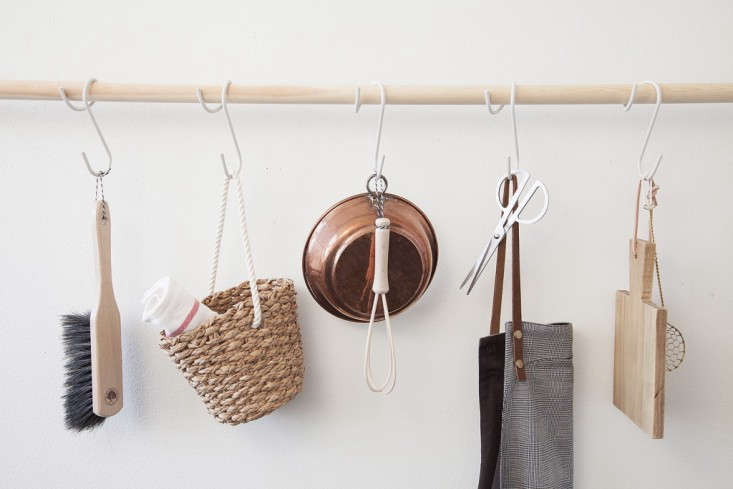
- Mix practical and decorative items, like a linen apron next to a wood-handled brush.
- Leave some breathing room between hooks so the setup looks edited, not frantic.
- Choose rail finishes and hook colors that work with your room, not against it.
A beautifully organized rail should feel like a clever design decision, not evidence that you recently binged five hours of decluttering videos.
The Bigger Lesson: Better Storage Is About Less Friction
The reason the Q Hook is interesting goes beyond hooks. It shows how good design often works. The best products do not reinvent human behavior. They support it. People will always yank a tote bag off a hook too quickly. They will always pull down an oven mitt with one hand while holding a pan in the other. They will always try to leave the house while carrying six things and remembering a seventh halfway out the door.
Smart storage accounts for that reality. It makes everyday behavior easier instead of demanding perfect habits. In that sense, the Q Hook is not revolutionary because it looks different. It is useful because it understands what people actually do.
And that is the real story behind “beyond the S hook.” The next step in home organization is not always a bigger system, a custom renovation, or a label maker with an inflated ego. Sometimes it is a tiny improvement to an old idea. Sometimes it is just a hook that finally stays where you put it.
Everyday Experiences: Living Beyond the S Hook
What does the Q Hook actually feel like in real life? Usually, the difference shows up in very ordinary moments. You notice it when you reach for a canvas grocery bag on your way out the door and the hook does not come with it. You notice it when you pull down your favorite apron before dinner and nothing clatters onto the counter. You notice it when your closet starts feeling less like a stuffed sandwich and more like a system with boundaries.
In a kitchen, the experience is especially satisfying. Picture a slim rail near the stove holding an oven mitt, a tea towel, and a small strainer. With standard S hooks, everything works until you are in a hurry. Then one quick tug sends the hook hopping sideways or falling completely. With a Q Hook, the motion feels calmer. The hook stays on the rail, the item comes off cleanly, and your cooking flow is not interrupted by a mini hardware rescue mission.
Closets tell a similar story. Many people use S hooks because accessories are awkward. Bags collapse. Belts disappear. Scarves multiply when nobody is looking. A Q Hook helps because it creates a stable place for those in-between items that do not belong folded and do not need a full hanger. A small row of hooks can hold a week’s worth of grab-and-go essentials: one tote, one cap, one scarf, one belt, one bag for the gym. Suddenly, getting dressed feels less like an archaeological dig.
Entryways may be where the Q Hook earns its best reviews in spirit, if not always in writing. The front door area is where organization goes to be tested by real human chaos. You are juggling keys, shoes, a water bottle, maybe a dog leash, maybe a child, maybe your own vanishing patience. In that environment, secure hooks are not a luxury. They are a public service. A hook that stays put makes the space feel more reliable, and reliable spaces are easier to keep tidy.
There is also a visual experience to consider. A row of loose S hooks can sometimes look temporary, even when the setup is functional. The Q Hook feels more deliberate. In an open closet, a tidy laundry area, or a visible kitchen rail, that matters. The space reads as designed rather than improvised. It is a small shift, but small shifts are often what make a room feel grown-up.
Of course, the Q Hook is not magic. It will not organize a chaotic house by itself, wash your dishes, or convince your family to return things to where they belong. That would require sorcery, not hardware. But as an everyday tool, it improves the rhythm of use. It reduces those annoying little failures that build up over time.
And that may be the most convincing experience of all. The Q Hook does not transform your life with drama. It improves it with consistency. You hang something up. You take it down. The hook stays put. The system works. You move on with your day. In the world of storage, that is a beautiful thing.
Conclusion
The Q Hook proves that even the most familiar household object can be improved when a designer pays attention to how people actually live. The S hook remains a classic for good reason, but the Q Hook refines the concept with better stability, a cleaner silhouette, and a more polished experience in everyday spaces. For kitchens, closets, entryways, and utility zones where items are constantly in motion, that tiny looped top makes a surprisingly big difference.
If your current hooks make your organization system feel flimsy, fussy, or one annoyed tug away from collapse, the Q Hook may be the small upgrade that finally makes the whole setup click. It is proof that smart storage is not always about buying more. Sometimes it is about choosing better.