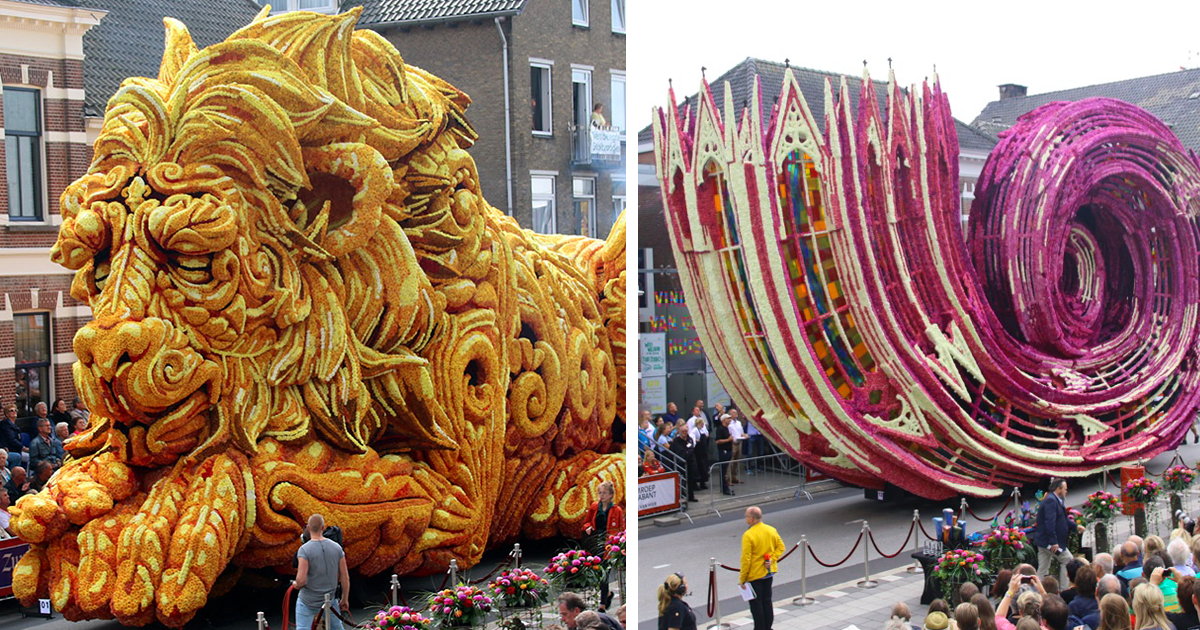

Imagine standing on a Dutch street while a nine-meter-tall creature made of dahlias slowly glides past you, pushed by volunteers, cheered by families, and scented like the world’s fanciest garden center. That is the magic of a Dutch flower parade, or bloemencorso, where flowers stop behaving like polite vase decorations and start acting like architecture, theater, sculpture, and occasionally a very dramatic dragon.
The Netherlands is famous for tulips, windmills, bicycles, canals, and people who can cycle through rain with the calm confidence of Olympic athletes. But its flower parades deserve a bigger spotlight. These events transform fresh blooms into monumental artworks: birds, boats, animals, fantasy figures, historic tributes, giant masks, surreal machines, and floral creatures so large they make regular bouquets look like shy interns.
Two of the best-known Dutch flower parade traditions are Corso Zundert, the world-famous dahlia parade held in September, and Bloemencorso Bollenstreek, the spring flower parade that travels through the Dutch Bulb Region from Noordwijk toward Haarlem. In 2021, Dutch corso culture was recognized by UNESCO as intangible cultural heritage, confirming what spectators already knew: this is not just “flowers on wheels.” It is community, engineering, design, horticulture, and competitive creativity rolled into one fragrant spectacle.
What Makes Dutch Flower Sculptures So Special?
A Dutch flower sculpture is not simply decorated; it is built. Teams often begin with drawings and scale models, then create steel, wood, wire, cardboard, and papier-mâché structures. Only in the final days do volunteers cover the entire surface with fresh blooms. In Zundert, dahlias dominate the parade. In the Bollenstreek spring parade, hyacinths, tulips, daffodils, and other bulb flowers create a different look and an unforgettable perfume. If you think a single hyacinth smells strong, imagine millions of them in parade formation. It is springtime with a megaphone.
The following 10 flower sculptures are inspired by real Dutch parade traditions, recurring themes, and well-known styles seen in the Netherlands’ most beloved flower parades. Some are based on specific types of floats that have appeared over the years, while others represent categories that return again and again because they work beautifully at gigantic scale.
10 Flower Sculptures From Dutch Flower Parades
1. The Giant Dahlia Dragon
If Dutch flower parades had a movie trailer, the giant dahlia dragon would be the opening shot. Dragons are ideal parade subjects because they combine movement, drama, texture, and a tiny suggestion that the float might breathe fire if the jury gives it a low score.
At Corso Zundert, where teams from local hamlets compete to create the most spectacular dahlia-covered float, dragon-like forms are especially powerful. Dahlias allow artists to build scales, eyes, claws, and muscular curves with surprising detail. Red, orange, burgundy, and yellow flowers create the illusion of heat, while darker blooms can give the creature depth and menace.
What makes a dragon sculpture unforgettable is not just its size. It is the way its head turns, jaw opens, wings rise, or tail curves around the float. Many Dutch floats include moving parts, and when a floral beast lumbers through narrow streets, spectators feel as if mythology has briefly borrowed a village road.
2. The Van Gogh Self-Portrait Tribute
Zundert is the birthplace of Vincent van Gogh, so it is no surprise that the town’s flower parade has celebrated the artist through monumental floral tributes. A Van Gogh-inspired flower sculpture is a fascinating challenge: how do you turn brushstrokes into petals?
The answer is color blocking, texture, and movement. Designers use dahlias almost like pixels, arranging them in bands and patches to suggest Van Gogh’s swirling style. Golden yellows, deep blues, rusty oranges, and earthy greens can echo the emotional palette of his paintings. A floral self-portrait does not need to copy a canvas perfectly. It needs to capture the energy: the restless line, the tilted gaze, the sense that the flowers themselves are thinking very hard about art.
These floats remind visitors that Dutch flower parades are not only cheerful festivals. They are also public art events, capable of honoring history, painters, local identity, and the strange beauty of turning a village street into an open-air museum.
3. The Tiger Carrying Her Young
Animal sculptures are crowd favorites because everyone understands them immediately. A tiger carrying her young, a type of dramatic animal scene associated with Dutch flower parade imagery, is especially effective because it blends power with tenderness. One moment you admire the big cat’s muscular shoulders; the next, you notice the cub and your heart makes a small squeaky noise.
For a sculpture like this, floral designers must think like both artists and wildlife illustrators. Orange and yellow dahlias can shape the tiger’s body, black or dark red flowers can create stripes, and white blooms can add highlights around the face. The cub must be smaller but still expressive, which is difficult when your “paintbrush” is a flower head.
The best animal floats feel alive from every angle. As the float turns a corner, the tiger’s head seems to shift, the cub becomes visible, and the crowd sees a new detail. That is the secret of great parade sculpture: it tells a story while moving at walking speed.
4. The Viking Ship With Dragon Heads
A Viking ship made of flowers sounds like something invented by a florist after too much coffee, but it fits Dutch corso culture perfectly. It has a long silhouette, fierce figureheads, carved-looking textures, shields, oars, and a built-in sense of adventure. Also, it gives designers a completely reasonable excuse to cover a dragon-headed boat in thousands of blossoms.
On a floral Viking ship, the hull may be formed with darker dahlias or earthy-toned flowers, while shields can become bright circular bursts of color. Dragon heads at the bow and stern add drama, and performers dressed as sailors or warriors can bring the sculpture to life. The result is part history lesson, part fantasy movie, part bouquet that appears to have conquered the North Sea.
This type of float shows how Dutch flower parades borrow from many visual worlds: folklore, mythology, maritime history, theater, and illustration. The flowers are fresh, but the storytelling can feel ancient.
5. The Giant Hedgehog With Pencil Spines
One of the joys of Dutch flower parades is their sense of humor. Not every sculpture needs to roar, conquer, or stare meaningfully like a post-impressionist painter. Some simply ask, “What if a hedgehog had pencil spines?” and then a community says, “Excellent question. Let’s spend months building it.”
A giant hedgehog with pencil-like spines is a wonderful example of playful surrealism. The round body can be covered in warm brown, cream, and tan flowers, while the pencil spines create vertical rhythm and comic exaggeration. It is instantly recognizable, slightly absurd, and perfect for families. Children love it because it looks like a storybook character. Adults love it because adults also secretly enjoy storybook characters, even when they pretend they are only there for the cultural heritage.
Floats like this prove that craftsmanship does not have to be stiff. The best Dutch flower sculptures are technically impressive, but they also wink at the crowd.
6. The Masked Burglar Float
A burglar, complete with mask, flashlight, and loot, may not sound like standard floral material. Yet that is exactly why it works. Flower parades thrive on visual surprise, and a comic thief made of dahlias turns a mischievous idea into a moving sculpture.
The design possibilities are endless. Dark flowers can form the burglar’s mask and clothing. Bright blooms can highlight a flashlight beam, a sack of stolen treasures, or exaggerated facial features. The float can lean into comedy, making the thief look panicked, sneaky, or comically incompetent. Nobody wants an actual burglar at a parade, of course. But a flower burglar? That is charming, as long as he does not steal the stroopwafels.
This sculpture type shows why the Dutch corso is more than flower arranging. It is narrative design. Each float must communicate its idea instantly to people standing several feet away, sometimes with music, performers, and motion adding to the scene.
7. The Butterfly and Bird Fantasy Float
Birds and butterflies appear often in flower parade design because they naturally belong to the floral world. They also give artists a chance to use bold color: purple wings, yellow bodies, red feathers, blue accents, and green foliage all working together like a flying garden that forgot gravity was required.
In the Bollenstreek spring parade, floats made with hyacinths, tulips, and daffodils often have a lighter, fresher feeling than dahlia floats. A butterfly sculpture can use hyacinths for dense color, tulips for elegant accents, and greenery for contrast. A bird float can stretch its wings across the platform, creating a sense of movement even when the float is parked for viewing.
These sculptures are especially photogenic. They look joyful in sunshine, dramatic under cloudy Dutch skies, and spectacular in close-up, where you can see each flower head placed like a tiny decision.
8. The Historic Hyacinth Whale
Bloemencorso Bollenstreek began after World War II, when communities in the Dutch Bulb Region wanted celebration, color, and connection. Early floats were modest compared with today’s enormous creations, but one historical image often associated with the parade’s beginnings is a whale-shaped float decorated with hyacinths.
The idea still feels brilliant. A whale offers a smooth, recognizable shape, perfect for covering with flower heads. Hyacinths provide dense color and a strong fragrance, turning the float into both a visual and sensory experience. Unlike dahlias, which dominate many late-summer corsos, spring bulb flowers bring the freshness of April and the famous Dutch flower fields into the parade route.
A whale sculpture also makes symbolic sense. It is huge, graceful, and slightly mysterious. In a parade context, it becomes a floating giant on wheels, swimming through streets instead of water. Only in the Netherlands can that sentence feel completely reasonable.
9. The Floating Vegetable-and-Flower Boat
Not every Dutch flower sculpture travels on land. Varend Corso Westland, the floating flower parade, sends decorated boats through waterways in the Westland region and nearby areas. These floating artworks often combine flowers, plants, fruits, and vegetables, celebrating the greenhouse and horticultural strength of the region.
A boat sculpture might feature orchids, chrysanthemums, sunflowers, dahlias, peppers, tomatoes, and tropical fruits arranged into a colorful theme. The result is a parade float that looks like a farmer’s market had a glamorous makeover and learned to sail.
The floating format changes the viewer’s experience. Instead of floats rolling past sidewalks, decorated boats glide along canals and waterways. Reflections double the color. Bridges become viewing platforms. The atmosphere is relaxed but festive, and the sculptures seem to drift rather than march. For travelers who love both flowers and Dutch water landscapes, this parade is a beautiful two-for-one deal.
10. The Giant Mask or Festival Face
Large faces and masks are common in parade art because they read clearly from a distance. In floral sculpture, they become even more striking. A giant face made of flowers can be joyful, mysterious, theatrical, or slightly strange in the best possible way.
Designers use contrasting colors to define eyes, cheeks, lips, eyebrows, and shadows. Purple hyacinths might shape a mask’s outline, yellow flowers can create highlights, red blooms can form lips or patterns, and greenery can soften the edges. Performers around the float may echo the same colors in costume, making the sculpture feel like the centerpiece of a larger stage.
A mask float captures something essential about Dutch flower parades: they are both real and dreamlike. You can see the volunteers, wheels, frames, and flowers. Yet the final effect feels like a carnival creature has stepped out of a fairy tale, looked around, and decided the Netherlands has excellent roads.
Behind the Beauty: How These Flower Sculptures Are Made
The biggest misconception about flower parades is that they are simply florist projects. In reality, they require engineering, agriculture, logistics, teamwork, and a heroic tolerance for working under deadline pressure. Communities often spend months planning and building the structures. The flowers themselves are attached only shortly before the parade, because fresh blooms do not politely wait around forever.
In Zundert, hamlets grow or source vast numbers of dahlias. Volunteers harvest and attach them during the final hectic days. In the Bollenstreek, teams use spring bulb flowers, especially hyacinths, whose fragrance fills the decoration halls. Visitors can often watch construction days and see the floats up close before they enter the route.
The process is delightfully intense. One person may be wiring flowers. Another may be adjusting a moving wing. Someone else may be solving the deeply specific problem of how to make a floral tiger’s nose look less like a potato. The final float looks magical because hundreds of tiny practical decisions are hidden underneath the petals.
Why Dutch Flower Parades Matter
Flower parades in the Netherlands are not only tourist attractions. They are community rituals. Children grow up watching parents, neighbors, and grandparents build floats. Local pride is strong, and the competition can be serious. Winning a parade prize is not just a nice ribbon moment; it is a village-level triumph that may be discussed with the intensity usually reserved for sports finals.
These parades also preserve traditional horticultural knowledge while encouraging contemporary design. A float can celebrate local agriculture, famous art, fantasy stories, environmental ideas, or pure visual comedy. That flexibility keeps the tradition alive. It is old enough to feel rooted, but inventive enough to avoid becoming dusty.
For international visitors, the appeal is simple: where else can you see monumental sculptures made from real flowers, created by volunteers, moving through streets or waterways, accompanied by music, theater, and the smell of spring or late-summer dahlias?
Visitor Tips for Seeing a Flower Parade in the Netherlands
If you want to see spring bulb flowers, Bloemencorso Bollenstreek is the classic choice. It usually takes place in April and passes through the flower region near places such as Noordwijk, Lisse, Hillegom, and Haarlem. It pairs well with a visit to the tulip fields or Keukenhof, though visitors should always respect field rules and avoid walking into working farms for photos.
If you want dramatic dahlia sculptures, Corso Zundert in September is legendary. The floats are huge, artistic, competitive, and often surreal. Arrive early, book accommodations in advance, and be prepared for crowds. Comfortable shoes are essential. So is a charged phone, because you will take “just one more photo” approximately 73 times.
For a different experience, consider Varend Corso Westland, where decorated boats bring flowers, plants, fruits, and vegetables to the water. It offers a uniquely Dutch mix of canals, horticulture, and festival atmosphere.
Personal Experiences and Reflections: What It Feels Like to Watch Dutch Flower Sculptures
The first thing you notice at a Dutch flower parade is not the size. It is the smell. Before the biggest float appears, the air changes. Hyacinths, dahlias, greenery, wet stems, street food, coffee, sunscreen, and the faint metallic scent of temporary barriers all mix together. It is not a perfume you can buy. It is the scent of a town temporarily becoming a garden with traffic control.
Then comes the sound. A band begins somewhere down the route. Children climb onto parents’ shoulders. Someone unfolds a tiny camping chair with the seriousness of a military operation. A local volunteer tells people to step back, gently but firmly. Dutch crowd management is calm, efficient, and somehow still friendly. You get the feeling that even the parade barriers have been planned by a committee with excellent snacks.
When the first giant flower sculpture turns the corner, the crowd reacts in layers. People gasp at the height. Then they laugh at the concept. Then they start pointing out details: the eye moves, the wing opens, the paws are made of darker flowers, the mouth has tiny highlights, the base is covered with foliage, the performers match the float. The longer you look, the more it rewards you.
What surprised me most is how handmade everything feels. These floats are enormous, but they do not feel industrial. You can sense the human labor in every inch. Each flower head has been placed by someone’s hand. Every color transition represents hours of sorting and pinning. Even the imperfections are charming. A petal curls. A stem sticks out. A painted eye looks slightly more dramatic than expected. It all adds life.
There is also a special joy in watching local pride move through the streets. The builders do not hide behind the artwork. They walk beside it, push it, guide it, fix it, cheer for it, and sometimes look at it with the exhausted love of people who have not slept much but have created something extraordinary. When spectators applaud, they are not only clapping for flowers. They are clapping for months of teamwork.
A flower parade also changes your sense of scale. After seeing a dahlia-covered dragon or a tulip-covered bird taller than a house, a normal bouquet seems very modest. Lovely, yes, but modest. You may return home, look at the vase on your table, and think, “Nice effort, little buddy.” That is the danger of Dutch floral spectacle: it raises your standards in the most unreasonable way.
For photographers, the experience is both thrilling and chaotic. The floats are huge, the crowds are dense, and the light may change every five minutes because Dutch weather enjoys plot twists. The best photos often come from details: a close-up of flower scales, a volunteer’s hands, a child staring upward, a performer laughing, or a row of dahlias forming the curve of an animal’s cheek. Wide shots capture the wow factor, but details capture the soul.
For travelers, the smartest approach is to slow down. Do not treat the parade like a checklist. Watch the float approach, pass, and disappear. Notice the back as well as the front. Listen to the music. Talk to locals if the moment feels natural. Try a snack. Accept that your camera roll will become 80 percent flowers and 20 percent accidental photos of strangers’ hats.
Most of all, let yourself enjoy the absurdity. A Dutch flower parade is beautiful, yes, but it is also wonderfully odd. Giant animals made from dahlias. Floating boats covered in vegetables. Historic figures built from petals. Mythical creatures pushed by volunteers in matching shirts. It is art with mud on its shoes and flowers in its hair. That combination is exactly what makes it unforgettable.
Conclusion
Flower sculptures from Dutch parades prove that fresh blooms can do far more than decorate a table. In the Netherlands, they become dragons, tigers, ships, portraits, birds, masks, boats, and comic characters. They carry local history, horticultural skill, volunteer pride, and a refreshing sense of humor.
Whether you visit the springtime Bloemencorso Bollenstreek, the dahlia-powered Corso Zundert, or the floating spectacle of Varend Corso Westland, you will see why Dutch flower parades are considered cultural treasures. They are temporary artworks, lasting only a short time before the flowers fade, but that is part of their magic. Like spring itself, they arrive in a rush of color, steal everyone’s attention, and leave people already planning to come back next year.