
Most people meet Grimm’s Fairy Tales in a cozy childhood setting: a polished picture book, a bedtime voice, maybe a cartoon castle glowing like it pays rent in a dream. Then, later, someone whispers, “Actually, the original Grimm stories were much darker,” and suddenly childhood feels like it has a secret basement.
But the story is more interesting than “old fairy tales were scary.” Jacob and Wilhelm Grimm did not publish one fixed, ancient book and walk away dramatically into the Black Forest. Their famous collection, Kinder- und Hausmärchen, or Children’s and Household Tales, first appeared in two early volumes in 1812 and 1815. Over the next several decades, the brothers revised, expanded, rearranged, softened, sharpened, and polished the tales through multiple editions, with the final major edition appearing in 1857.
That means “Grimm’s Fairy Tales” is not one thing. It is a moving target wearing a red cloak, carrying breadcrumbs, and occasionally turning someone into a bird. The first edition was rougher, shorter, stranger, and often closer to notes from informants and older oral traditions. Later editions became more literary, more moral, more family-friendly in some places, and more dramatic in others.
So what changed after the first edition? Quite a lot. Here are five major ways Grimm’s Fairy Tales evolved from scholarly folklore collection into the classic fairy-tale universe many readers know today.
1. The Stories Became Longer, Smoother, and More Literary
The first edition of Grimm’s Fairy Tales can feel surprisingly abrupt. Some stories move with the speed of gossip overheard in a kitchen: “A girl was cursed, a prince arrived, someone got punished, good night.” Later editions often added transitions, emotional beats, descriptive details, and a more polished narrative rhythm.
This change matters because it shifts the Grimms from collectors toward literary editors. At first, Jacob and Wilhelm Grimm presented themselves as preservers of folk tradition. They wanted to record what they believed were traces of old German cultural memory before those oral traditions disappeared. In practice, their sources were more complicated than the romantic image of elderly peasants telling stories beside a fire. Many informants came from educated, middle-class circles, and some tales were influenced by written European traditions.
Still, the first edition often kept a spare, jumpy quality. Later, Wilhelm Grimm in particular shaped the tales into smoother reading experiences. Sentences became fuller. Motivations became clearer. Scenes became more dramatic. Characters spoke in more polished dialogue. The stories began to sound less like raw field notes and more like literature designed for family reading.
Example: “Briar Rose” Becomes More Enchanted
In early forms, “Briar Rose,” better known in English as “Sleeping Beauty,” was simpler and more direct. Later versions lingered over the enchanted sleep spreading through the palace: horses, dogs, pigeons, flies, fire, food, servants, and even the wind fall still. That kind of expansion turns a plot point into an atmosphere. The story no longer just tells us a princess sleeps; it makes the entire world hold its breath.
This is one reason later Grimm tales became so memorable. They gained texture. The forest felt deeper. The castle felt older. The curse felt heavier. The downside is that some of the first edition’s odd, sharp, unpredictable flavor became smoother, like a wild apple baked into a respectable pie.
2. Biological Mothers Often Became Stepmothers
One of the most famous changes in Grimm’s Fairy Tales involves bad mothers. In several early versions, the dangerous woman in the house was not a stepmother. She was the child’s biological mother. Later editions often transferred that cruelty to a stepmother instead.
The best-known examples are “Hansel and Gretel” and “Snow White.” In earlier versions of “Hansel and Gretel,” the mother participates in the plan to abandon the children in the forest. Later, the figure becomes a stepmother, while the father is presented as more reluctant and sorrowful. In early versions connected to “Snow White,” the jealous queen figure is closer to a biological mother; later versions turn her into the more familiar wicked stepmother.
Why make that change? Partly because the Grimms were increasingly shaping the tales for children and respectable family audiences. A mother who abandons or tries to destroy her own child was apparently too brutal for the moral universe they wanted to build. A stepmother, on the other hand, could carry the blame while preserving the ideal of sacred motherhood.
There was also a social reality behind the pattern. In earlier centuries, childbirth was dangerous, many children lost mothers young, and fathers often remarried. Blended households could create real tensions over inheritance, food, attention, and survival. Fairy tales exaggerated those anxieties into memorable villains. The wicked stepmother became a convenient container for fears about family instability.
What This Did to the Stories
This change made the tales more emotionally acceptable for family reading, but it also changed their psychological force. A story about a mother endangering her child points straight at the darkest fears inside the home. A story about a stepmother creates distance. The horror is still in the house, but now it has been given a label that feels safely “other.”
In other words, the Grimms did not simply remove cruelty. They reassigned it. The family remained dangerous, but the official image of motherhood received a protective cloak. Apparently, even fairy-tale editors knew when a public-relations department was needed.
3. Sexual References Were Removed or Disguised
If violence often remained in Grimm’s Fairy Tales, sexual material was treated very differently. Across later editions, references to pregnancy, desire, and bodily knowledge were removed, softened, or rewritten into more innocent plot devices.
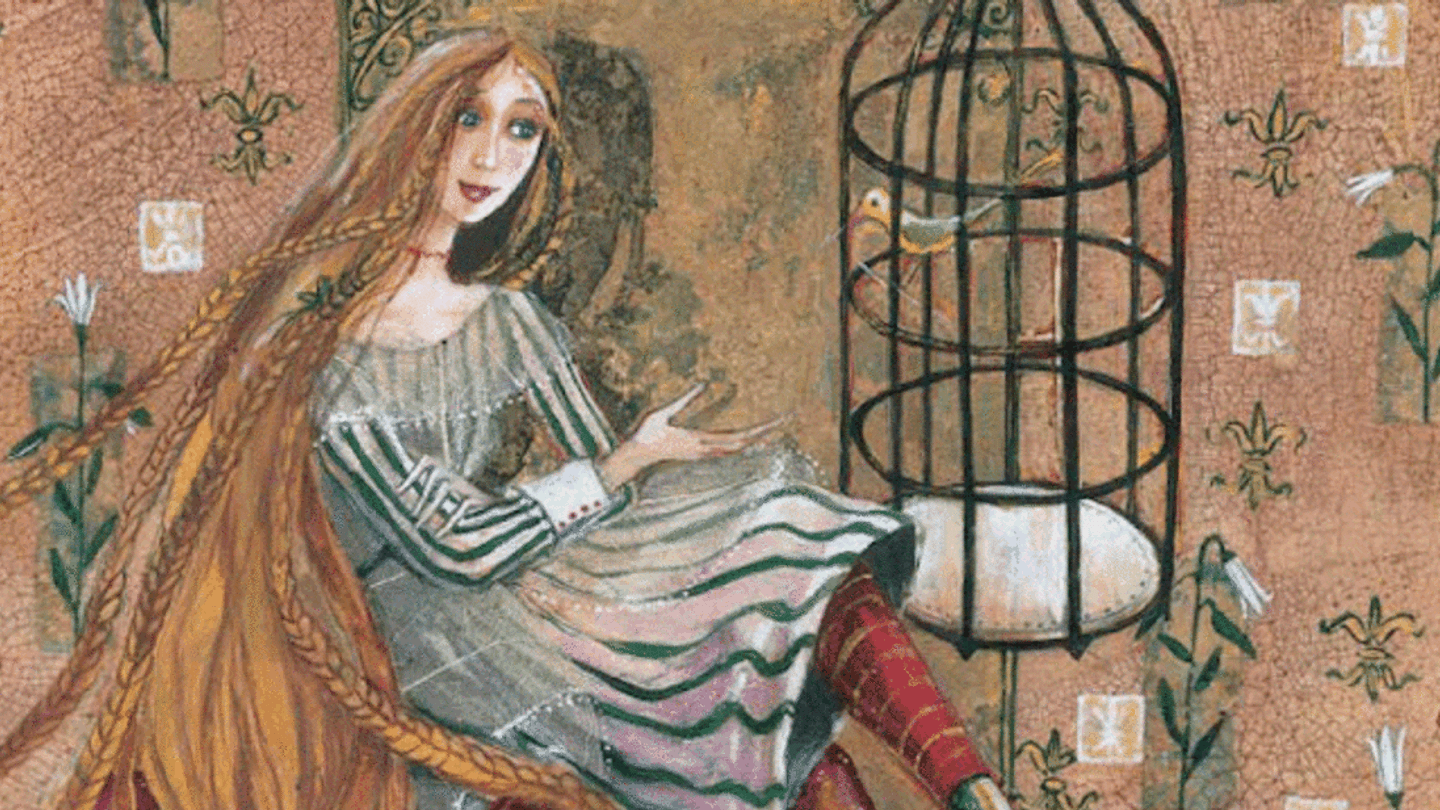
“Rapunzel” is the classic example. In the first edition, Rapunzel accidentally reveals her relationship with the prince when she wonders why her clothes have grown too tight. The implication is not exactly hidden under seven mattresses: she is pregnant. Later editions remove that clue. Instead, Rapunzel gives herself away by asking why it is harder to pull up the old enchantress than the young prince.
That later version keeps the plot moving without admitting what has really happened. It is the fairy-tale equivalent of cutting away from a scene and showing two birds flying past a tower. Subtle? Not really. Effective for nineteenth-century respectability? Absolutely.
This editorial pattern tells us a lot about the intended audience. The first edition was not purely a children’s book in the modern sense. The Grimms were scholars, and many oral tales had circulated among adults. Later, as the collection became more popular and more closely associated with children and family reading, sexual content became harder to justify.
Violence Stayed, But Sex Had to Leave the Room
Modern readers may find the contrast strange. A child can be abandoned in a forest, a villain can be punished severely, and a witch can threaten to cook dinner in the most alarming way possible. But pregnancy? Suddenly everyone clutches pearls.
That is not accidental. Nineteenth-century editors and readers often considered sexual knowledge more dangerous to children than violence. Fairy-tale justice could include frightening punishment, but sexual experience challenged ideals of innocence, obedience, and proper family morality. So the Grimms cleaned up certain kinds of adult content while leaving many dark and brutal story structures intact.
The result is a collection that can feel morally uneven: less frank about bodies, but still perfectly comfortable with forests full of hunger, danger, and punishment.
4. Magic Was Recast, Moralized, and Sometimes Christianized
The first Grimm edition contains a fairy-tale world that is weird, fluid, and not always neatly moral. Later editions increasingly organize that world into a more polished moral framework. Supernatural figures were renamed, Christian language became more prominent in some tales, and moral lessons grew clearer.
One interesting change involves the word “fairy.” In some early contexts, magical helpers or powerful women could be called fairies. Later, the Grimms often replaced fairies with terms such as sorceresses, wise women, or enchantresses. This was partly cultural and linguistic. The Grimms were invested in German tradition, and “fairy” carried associations with French literary fairy tales. Recasting these figures made the stories feel more rooted in the Germanic world the brothers wanted to preserve.
But the change was not just vocabulary. Later editions often made the tales more morally legible. Good children became more obedient. Villains became more clearly wicked. Rewards and punishments felt more deliberately arranged. The mysterious logic of oral storytelling was gradually dressed in Sunday clothes.
The Tales Became More Respectable
This does not mean the stories became boring. The Grimms were too good at atmosphere for that. But later versions often guide the reader more firmly. Instead of leaving a strange event floating in ambiguity, they nudge it toward a lesson: be humble, keep promises, honor parents, fear greed, avoid vanity, help the weak, and please do not make bargains with suspicious little men who refuse to give references.
That moral shaping helped the collection survive as children’s literature. Parents and teachers could defend the stories as instructive, not merely bizarre. The problem is that some of the unruly energy of the first edition became domesticated. The tales still had teeth, but now the teeth were wearing a necktie.
5. Some Tales Were Cut, Others Added, and the Whole Collection Was Curated
The first edition was not simply revised line by line; the collection itself changed. Some tales disappeared from later editions, while new ones were added. The Grimms received more material over time and also became more selective about what belonged in the book.
The early edition included stories that were difficult to reshape for polite family reading. One infamous example is “How Some Children Played at Slaughtering,” a grim little tale about children imitating adult violence with horrifying consequences. Even by Grimm standards, it is a lot. There are dark fairy tales, and then there are stories that make a bedtime lamp quietly resign from its job.
As later editions developed, the Grimms had to decide what could remain, what should be changed, and what should be removed. They also added tales that became central to the collection’s identity. By the final edition, the book had grown into a larger, more curated body of stories than the original 1812 and 1815 volumes.
Curation Changed the Meaning of “Grimm”
When readers today say “Grimm’s Fairy Tales,” they often imagine a stable canon: “Cinderella,” “Little Red Riding Hood,” “Rapunzel,” “Snow White,” “Hansel and Gretel,” “Rumpelstiltskin,” and “The Frog King.” But the collection was built through decades of editorial decisions. What counted as a Grimm tale was not fixed from the beginning.
This is important for SEO readers, literature students, teachers, and fairy-tale fans alike: the Grimms were not neutral recording machines. They were scholars, nationalists, editors, stylists, and cultural gatekeepers. They preserved stories, yes, but they also shaped what later generations would think “traditional fairy tale” means.
Why These Changes Matter Today
The evolution of Grimm’s Fairy Tales matters because it shows how stories become classics. A classic is not always born polished. Sometimes it begins as a bundle of fragments, memories, borrowed plots, oral performances, local anxieties, and editorial ambitions. Then generation after generation sands it down, paints it, markets it, argues over it, and reads it to children who may or may not sleep afterward.
The Grimms’ revisions also challenge the idea of a single “original” fairy tale. Oral stories are living things. They change with each teller. The first edition of the Grimms’ collection is earlier, but it is not pure in some magical laboratory sense. It already reflects choices: who told the tales, who wrote them down, what language was used, what sources were trusted, and what the brothers believed folklore should represent.
Later editions added another layer of choices. They made the tales more readable, more respectable, more Christian in tone, more suitable for middle-class families, and more recognizable as the fairy tales that shaped modern children’s literature.
Reading Experience: What the First Edition Feels Like Today
Reading the earlier Grimm tales after knowing the polished versions is a little like finding the rough sketches behind a famous painting. The familiar shapes are there, but the lines are stranger. The stories feel less like carefully packaged lessons and more like messages carried through bad weather.
The first thing a modern reader may notice is speed. Early tales do not always pause to explain themselves. A bargain happens. A child is lost. A spell lands. A punishment arrives. Nobody steps forward to say, “And the moral of the story is…” The reader has to sit with the weirdness. That can be refreshing, especially in a media world where every character now seems required to explain their trauma, motivation, and personal brand strategy before breakfast.
The second experience is discomfort. Earlier Grimm stories can be blunt about hunger, abandonment, jealousy, family conflict, and survival. They come from a world where danger was not a metaphor hiding in a symbolic forest. The forest was real. Scarcity was real. Losing a parent was common. A household could become unstable very quickly. When these tales talk about children being sent away, mothers dying, fathers remarrying, or food running out, they are not just being spooky. They are turning social fears into story form.
The third experience is surprise. Many readers expect the first edition to be “more violent” in a simple, horror-movie way. Sometimes it is darker, yes, but the more fascinating difference is tone. The earliest versions can be more abrupt, less sentimental, and more morally puzzling. Later editions often tell readers how to feel. Earlier versions are more likely to drop a strange event on the table and walk away whistling.
For writers, this is a valuable lesson. Revision does not only improve language; it changes meaning. When the Grimms turned mothers into stepmothers, removed pregnancy from “Rapunzel,” renamed fairies, expanded scenes, and cut certain tales, they changed the emotional architecture of the collection. The plot may look similar, but the story’s center of gravity moves.
For parents and teachers, the editions offer another lesson: children’s literature has always involved negotiation. Adults decide what children should know, fear, laugh at, or question. The Grimms’ later versions reveal nineteenth-century ideas about innocence and morality. Our modern retellings reveal our own. Every generation edits the forest before inviting children inside.
For casual readers, the best experience may be comparing versions side by side. Read an early “Rapunzel,” then a later one. Look at “Hansel and Gretel” before and after the mother becomes a stepmother. Notice how a small wording change can move blame, protect an ideal, or make a story easier to sell as bedtime material. It is literary detective work, but with more towers, wolves, and suspicious old women.
Most of all, reading the first edition reminds us that fairy tales are not fragile antiques. They are tough, adaptable little machines. They survive because they can be retold. The Grimms changed them. Translators changed them. Disney changed them. Novelists, filmmakers, teachers, and internet writers keep changing them. The question is not whether fairy tales should change. They always have. The better question is: what do our changes reveal about us?
Conclusion: The Grimms Did Not Just Collect Fairy Tales They Rebuilt Them
The first edition of Grimm’s Fairy Tales was shorter, rougher, stranger, and less clearly aimed at children than the versions most readers know. Across later editions, Jacob and especially Wilhelm Grimm expanded the stories, polished the prose, adjusted troubling family dynamics, removed sexual references, reshaped supernatural figures, added moral and religious coloring, and curated the collection for a broader audience.
These changes helped transform a scholarly folklore project into one of the most influential works in world literature. They also remind us that fairy tales are never frozen. They are edited by culture, fear, taste, politics, parents, publishers, and readers. The Grimms’ forest is not a museum. It is alive, shifting, and still full of footprints.