
Wallpaper has a funny way of making a room look expensive even when your budget is whispering, “Please be reasonable.” But before you fall in love with a bold botanical, a moody stripe, or that peel-and-stick print that promises a five-star glow-up, there’s one unglamorous task standing between you and a beautiful wall: measurement.
And yes, measuring for wallpaper can feel like math showed up to a decorating party uninvited. The good news is that it’s not difficult when you break it into a few logical steps. The even better news? Doing it right saves money, prevents mid-project panic, and keeps you from ordering “just one more roll” while standing in your pajamas at 11:47 p.m.
In this guide, you’ll learn exactly how to measure for wallpaper in seven steps, how to handle tricky doors and windows, why pattern repeat matters more than most people expect, and how to estimate the right number of rolls without crossing your fingers and hoping for the best.
Why Accurate Wallpaper Measurements Matter
Wallpaper is not like paint, where an extra gallon can quietly wait in the garage for touch-ups. Wallpaper comes in specific roll widths, lengths, and pattern repeats. That means your usable material depends on more than just square footage. You also need to think about strip width, wall height, trimming allowance, matching the design from one strip to the next, and whether you’re covering a whole room or only one accent wall.
A tiny measuring mistake can snowball into a very annoying reality: a wall that needs five strips, but only four fit from the roll lengths you bought. That’s why smart wallpaper planning is less about “roughly enough” and more about “confidently enough.”
Tools You’ll Want Before You Start
- Tape measure or laser measure
- Step stool or ladder
- Notebook or notes app
- Pencil
- Calculator
- Level or straightedge
- The wallpaper product details, especially width, roll length, and pattern repeat
That last item matters a lot. You cannot estimate wallpaper properly without knowing the actual product specs. One wallpaper may come in a traditional double-roll format, while another peel-and-stick option may cover a much smaller area. Same wall, very different shopping cart.
Step 1: Decide Exactly What You’re Covering
Before you measure anything, define the project. Are you wallpapering one accent wall, all four walls, a powder room, a nook, or the wall above wainscoting? Do not trust your memory. “I’m doing the whole room” has a sneaky habit of turning into “Well, except behind the giant cabinet, around the built-in, and maybe not that tiny return wall near the doorway.”
Walk the room and list every wall section that will receive wallpaper. If you have bump-outs, alcoves, soffits, angled ceilings, or a chimney breast, write those down separately. Wallpaper math gets much easier when you break the room into individual surfaces instead of trying to measure the whole space like you’re solving a geometry riddle on a game show.
Pro tip
If you are only doing an accent wall, measure only that wall. If you are doing a full room, measure every wall section one by one and label them clearly.
Step 2: Measure the Width of Each Wall
Now measure the horizontal width of every wall you plan to cover. Write each width down separately, then add them together for your total width. If the room is not perfectly square, congratulations, your house is normal. Measure each wall independently rather than assuming matching walls are exactly the same.
For walls with windows, doors, or built-ins, still measure the full wall width first. You can make adjustments later if the manufacturer’s calculator calls for it. Many wallpaper installers prefer to think in full strips instead of aggressively subtracting openings, because you often still need complete lengths of paper to keep the pattern aligned. In other words, a window does not magically turn leftover scraps into full usable strips.
If a wall has a small return around a corner, measure that too. Corners are not decorative suggestions; wallpaper has to turn them, and that requires paper.
Step 3: Measure the Height at More Than One Point
Next, measure the wall height from ceiling to baseboard or from ceiling to the stopping point where the wallpaper will end. Measure in at least two or three places on each wall, especially in older homes. Floors and ceilings love pretending to be level while quietly doing no such thing.
Use the largest height measurement for your calculations. This gives you a safer estimate and helps account for walls that are a little out of plumb. If you have vaulted ceilings, stair walls, or sloped areas, measure the tallest point unless you are creating a very precise cut layout for a specialty installation.
This is also the step where you add trimming allowance. A good rule is to add a few extra inches to each strip so you can trim neatly at the ceiling and baseboard. Think of it as giving yourself breathing room. Wallpaper without trimming allowance is like trying to parallel park with your eyes closed: technically possible, emotionally unnecessary.
Step 4: Calculate How Many Strips You Need
Wallpaper is usually installed in vertical strips, so one of the best ways to estimate quantity is to figure out how many strips your wall width requires. To do that, divide the total width of the area by the width of your wallpaper roll or panel.
Here’s a simple example:
If your total wall width is 144 inches and your wallpaper is 20.5 inches wide, divide 144 by 20.5. That gives you about 7.02, which means you need 8 full strips. Always round up. Wallpaper does not reward optimism.
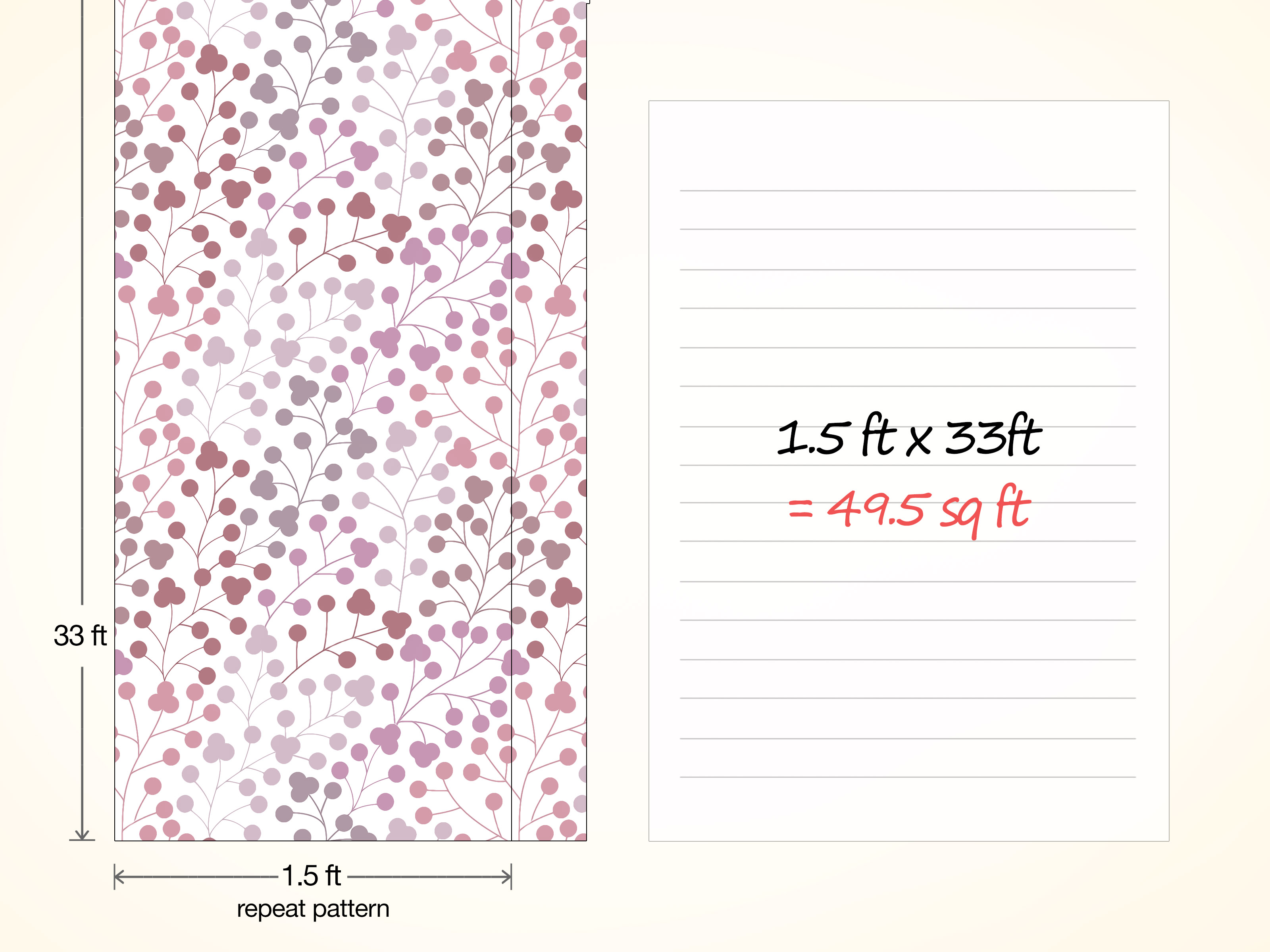
If you are using mural panels or wide peel-and-stick panels, use the product’s actual panel width rather than assuming a standard wallpaper roll size. Some brands use very different dimensions, and that changes everything.
Quick formula
Total wall width ÷ wallpaper width = number of strips needed
Round up to the next whole number every time.
Step 5: Account for Pattern Repeat and Waste
This is the step many first-time DIYers skip, and it is exactly how people end up one roll short while making intense eye contact with the wall.
If your wallpaper has a pattern repeat, you will likely need extra length on each strip so the design lines up properly from strip to strip. A floral, geometric, plaid, or scenic pattern may require more paper than a random or texture-like print. Drop matches can be especially greedy. Beautiful, yes. Efficient, not always.
Check the wallpaper label or product page for the pattern repeat information. Then add enough length to each strip to allow for matching. Also include your trimming allowance. This adjusted strip length is what you should use when calculating how many usable strips come from each roll.
Even if your wallpaper is a peel-and-stick product marketed as renter-friendly and beginner-friendly, pattern repeat still matters. Friendly wallpaper can still be dramatic wallpaper, and dramatic wallpaper usually demands extra paper.
Smart rule of thumb
If the wallpaper has a visible repeat, order extra. If the print is large-scale, order a little more extra. If you are the kind of person who has ever said, “I’ll probably get it perfect on the first try,” order even more extra.
Step 6: Convert Strips into Rolls
Once you know your strip length and the number of strips you need, figure out how many usable strips come from one roll. Then divide the total strips needed by the usable strips per roll.
Example:
- You need 8 strips
- Each roll yields 3 usable strips after allowing for height, trimming, and pattern repeat
- 8 ÷ 3 = 2.67
- You must round up to 3 rolls
If you are working from square footage instead, check the manufacturer’s listed roll coverage and be careful. Some traditional products are sold as single rolls but packaged only as double rolls. Some peel-and-stick rolls cover closer to the high-20s or low-30s in square feet. Others are different again. This is why the product page is your best friend during the measuring stage.
If the brand offers a wallpaper calculator, use it after you do your own math. It is a great way to double-check your estimate and catch any surprises related to pattern repeat or roll format.
Step 7: Add a Safety Margin Before You Order
Never order the exact minimum unless you enjoy suspense in all home improvement projects. It is usually wise to buy extra wallpaper for trimming, pattern matching, damaged cuts, awkward corners, and future repairs. An extra roll can be the difference between a smooth project and a frantic hunt for a discontinued dye lot six months later.
This matters even more if:
- Your wallpaper has a large or complex pattern repeat
- Your room has lots of corners, windows, or architectural interruptions
- You are wallpapering a bathroom, hallway, or older room with uneven walls
- You are a beginner
- You want leftovers for future patching
And yes, leftovers may feel annoying in the moment. But leftover wallpaper is still better than discovering you need one more strip and the next batch does not match your original run. That is not “character.” That is a decorating villain origin story.
Should You Subtract Doors and Windows?
This is one of the most confusing parts of measuring for wallpaper because different calculators and brands handle it differently. Here’s the practical answer: for basic estimating, some methods subtract large doors and windows from the total coverage area. Other methods keep the full wall measurement because installation is based on vertical strips, and those strips often run right over openings before being trimmed out.
The safest approach is this:
- For a quick strip-based estimate, do not over-subtract small openings.
- For a square-foot estimate, subtract major openings only if the manufacturer’s system recommends it.
- For rooms with many openings, compare your manual estimate with the brand’s calculator.
If a door or window is enormous and eliminates several full strips, that can affect the order. If it is a standard window in a patterned room, the savings may be less impressive than you think.
Common Wallpaper Measuring Mistakes to Avoid
- Measuring only one wall height: Uneven ceilings are common.
- Ignoring pattern repeat: This is the classic “why am I short on wallpaper?” mistake.
- Using square footage alone: Strip yield matters just as much.
- Forgetting corners and returns: Tiny wall sections still require paper.
- Skipping extra material: Mistakes, trims, and future repairs happen.
- Assuming all rolls are standard: Roll width and length vary by brand and product type.
A Simple Wallpaper Measuring Example
Let’s say you want to paper one wall that is 12 feet wide and 8 feet high.
- Wall width: 12 feet = 144 inches
- Wallpaper width: 20.5 inches
- 144 ÷ 20.5 = 7.02, so you need 8 strips
- Wall height: 96 inches
- Add 4 inches for trimming = 100 inches per strip
- If pattern repeat increases your strip requirement to 108 inches, use that number instead
- If one roll gives you 3 usable strips, 8 strips means 3 rolls minimum
- Add extra for safety, especially if the pattern is bold
That is the basic rhythm of wallpaper measurement: width tells you the number of strips, height tells you strip length, and the product specs tell you how many rolls those strips require.
Real-World Experiences: What Measuring for Wallpaper Actually Feels Like
People often imagine wallpaper projects beginning with a dramatic unrolling of gorgeous paper and ending with a magazine-worthy reveal. In real life, the project usually begins with someone staring at a tape measure and wondering why one side of the room is somehow taller than the other. That experience is incredibly common, and it teaches an important lesson fast: walls are rarely as tidy as they look from across the room.
One of the most common experiences homeowners talk about is the surprise of pattern repeat. On paper, the wall seems to need only a certain amount of material. Then the wallpaper arrives, the first strip goes up, and suddenly every next piece needs extra length so the leaves, stripes, birds, or geometric shapes line up correctly. That moment can be humbling. It is also why experienced installers sound so insistent when they say to check the repeat before ordering. They are not being dramatic. They have simply lived through the alternative.
Another familiar experience is discovering that doors and windows do not save as much wallpaper as people think they will. A beginner often assumes that a large window means a large reduction in materials. Then they learn that the strips still need to fall in the correct places, wrap corners cleanly, and preserve the pattern flow across the wall. Suddenly, the “saved” paper becomes a few awkward offcuts that are useful for small patches but not for a full strip. It is a classic case of home improvement looking easier in theory than in practice.
There is also the oddly universal experience of measuring the same wall three times and getting three slightly different numbers. This usually happens in older homes, charming homes, rushed homes, or, frankly, most homes. Measuring at the left, center, and right side of a wall often reveals subtle differences that matter once wallpaper enters the scene. People who take the largest number instead of the most convenient number are usually the ones who avoid trouble later.
Many DIYers also describe a shift in confidence after they switch from square-foot thinking to strip thinking. At first, wallpaper seems like paint with extra personality. Then it becomes clear that wallpaper behaves more like a puzzle. Once people start asking, “How many full strips do I need?” rather than “How many square feet is this wall?” the project suddenly makes more sense. It feels less mysterious and much more manageable.
And then there is the emotional experience of ordering extra. Nearly everyone resists it at first. Nobody wants to spend more money than necessary. But the homeowners who end up happiest are often the ones who kept one extra roll in reserve. It helps with mistakes, damaged cuts, future touch-ups, and those moments when a supposedly straight corner turns out to have a rebellious personality. Extra wallpaper may not feel exciting when you order it, but it feels downright heroic when you need it.
In the end, measuring for wallpaper is less about being a math genius and more about being patient, observant, and just a little skeptical of your walls. The process gets easier with each step, and by the time the paper finally goes up, the measuring phase stops feeling like a chore and starts feeling like the reason the finished room looks so polished. In other words, the tape measure may not get the glamour, but it absolutely earns the credit.
Final Thoughts
If you want wallpaper that looks crisp, professional, and intentional, measurement is where the magic begins. The smartest way to measure for wallpaper is to think in strips, use the largest wall dimensions, account for trimming and pattern repeat, and always check the specific product details before you buy. Add a small safety margin, and you will save yourself a big headache later.
So yes, wallpaper can transform a room. But first, it asks for ten calm minutes, a tape measure, and a little respect for geometry. Honestly, that is a fair deal.