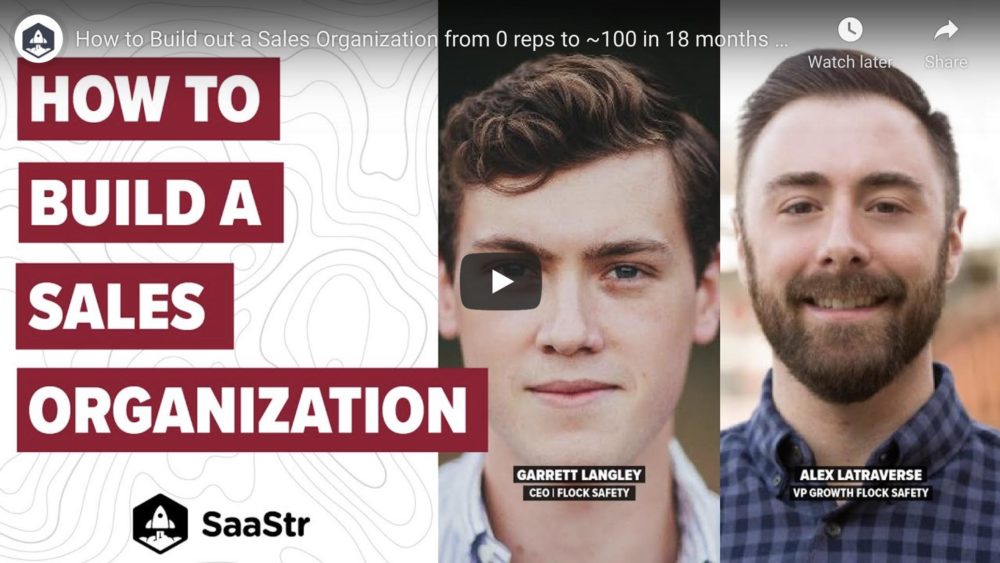

Going from zero sales reps to ~100 in 18 months is the kind of sentence that makes founders spit coffee onto their keyboards.
It sounds like a motivational poster… until you realize it also sounds like a payroll system having a panic attack.
Yet that’s exactly what SaaStr Podcast 434 digs into: how Flock Safety scaled its go-to-market engine at warp speed without turning the org into a chaotic “everyone sells differently” improv show.
In the episode (published March 5, 2021), SaaStr’s team highlights a conversation with Garrett Langley (Founder & CEO) and Alex Latraverse (VP of Growth at the time),
explaining the decision points, the operating system, and the unglamorous mechanics behind their sales team’s growth.
If you’re building a sales organizationwhether you sell pure SaaS, hardware-enabled SaaS, or “SaaS… but with cables”this is a masterclass in scaling with intention.
Why This Episode Hits Different: Flock Safety Isn’t a Typical SaaS Motion
Flock Safety is often described as a hardware-enabled SaaS company focused on helping communities reduce crime.
That matters because the sales motion tends to be more operationally intense than “start a free trial and invite your team.”
You’re frequently selling to stakeholders who care about reliability, outcomes, policy, and trustplus the product lives in the real world, not just the cloud.
That combination creates a unique scaling challenge: you need a sales team that can handle a consultative, outcome-driven deal,
while the rest of the company can deliver on what’s sold (installations, onboarding, support, data workflows, and the full customer lifecycle).
The podcast’s big idea isn’t “hire faster.” It’s “scale only when your system can survive it.”
The Three Green Lights Before You Scale Sales
In the SaaStr recap, Flock’s leadership points to three signals that told them it was time to step on the gas.
This is the part most teams skipthen wonder why “growth” feels like a stress rash.
1) You’ve Actually Hit Product–Market Fit (Not Just Product–Founder Excitement Fit)
One practical indicator mentioned: the CEO felt he could reliably “bet” on a certain amount of ARR per business trip.
In other words, outcomes were becoming predictable across quarters, not dependent on a single heroic close or a lucky inbound spike.
Predictability is what makes scaling rational instead of theatrical.
2) You Remove the Founder Effect (Because Founders Can’t Take 50 Meetings a Week Forever)
Founder-led sales is powerful earlyfounders can adapt, improvise, and brute-force learning.
But it’s also dangerous because it can hide whether the company has a repeatable motion.
Flock reportedly tested selling without the founder involved, then used the results to define a profile and method that worked independently of “CEO charisma.”
3) You Hire Sales Leadership That Knows How to Scale (and You Align on Risk)
A key takeaway: the CEO determines when to scale and sets the organization’s risk tolerance.
Then leadership (like a VP of Sales/Growth) builds the system to scale responsibly.
This alignment matters because hiring 30, 50, or 100 reps isn’t just a headcount decisionit’s a cashflow decision, a culture decision, and a customer experience decision.
The “Hire 30 Reps in 30 Days” Moment: Scaling Starts With Recruiting Math
The episode includes a memorable detail: when Garrett interviewed Alex, the challenge was to hire 30 reps in the first 30 days.
Alex’s first question was essentially, “Cool. How many recruiters are we hiring?”
That’s not sarcasmit’s systems thinking.
Build a Recruiting Strategy Like It’s a Pipeline (Because It Is)
If you need 30 hires fast, you don’t “post and pray.”
You build a recruiting pipeline: sourcing channels, screening steps, interviewer training, and a consistent scorecard.
The goal is repeatabilityso you can hire at volume without lowering the bar or improvising qualifications mid-process.
Define the Profile First, Then Scale the Process
One of the biggest practical lessons from the SaaStr recap: create a clear profile for the kind of rep your business needs.
Are you selling transactional SMB deals? Enterprise with committees? Public-sector budget cycles? Expansion-heavy land-and-expand?
Different motions require different strengths, and “good salesperson” is not a job requirementit’s a vague compliment.
Yes, Eight Interview Rounds Sounds IntenseThat’s the Point
The recap notes that Flock ran many interview rounds (eight are mentioned).
That’s not because they love Zoom calls. It’s because at high scale, one bad hiring “batch” can destabilize performance, morale, and customer experience.
Rigorous hiring becomes a form of risk management.
Headcount Is a Result, Not the Goal
Another subtle but critical note: they pivoted away from “we need X reps” to “we need Y revenue.”
Revenue targets force clarity on ramp time, quota, win rates, pipeline coverage, and whether the business can onboard customers at the same speed it sells them.
Headcount targets can become vanity metrics in disguise.
Compensation: The Part Everyone Pretends Is Simple (Until It Isn’t)
Compensation is where strategy becomes behavior.
Your comp plan doesn’t just pay peopleit tells them what matters, what to prioritize, and what “good” looks like on a Tuesday.
The SaaStr summary emphasizes designing comp so it’s financially safe for the business and attractive for recruitingwithout creating an Excel labyrinth.
Align Incentives With Consistency, Not Just Heroics
A strong plan rewards repeatable performance, not only “one monster quarter then vanish.”
That can mean thoughtful quota periods, clean definitions of attainment, and incentives that reflect the company’s actual growth goals
(new logos, expansion, multi-year deals, product mixwhatever truly moves the business).
Use Ramp-Friendly Targets and MBOs When You’re Hiring in Waves
When you onboard reps in cohorts, you need a ramp system that doesn’t punish new hires for not being fully productive in week two.
The recap references tools like ramp-specific goals and short-term targets (including half-year quotas) so reps have clarity and momentum while learning.
Accelerators Can WorkIf You Keep the Plan Understandable
Accelerators are a classic lever to reward overperformance, but the goal is motivation, not confusion.
The more complex the plan, the more time reps spend calculating payouts instead of building pipeline.
Great sales orgs treat comp design as a product: simple UX, clear rules, and outcomes aligned with business health.
Onboarding at Scale: Don’t Turn Your Best Reps Into Full-Time Trainers
Hiring fast breaks onboarding fastunless you design for it.
The recap highlights an approach that many scaling orgs eventually adopt: onboarding in classes, not as a constant drip of random new hires.
It’s easier to maintain quality, consistency, and culture when onboarding is structured and repeatable.
Cohort Onboarding Protects the Org’s Focus
When new hires arrive nonstop, your experienced reps and managers get pulled into ad-hoc training constantly.
That slows down the people carrying quota todaythe ones funding tomorrow’s growth.
Cohorts let you plan enablement, schedule shadowing, and build shared momentum among new reps.
Build a Repeatable Sales Process (So “Best Practices” Aren’t Tribal Knowledge)
The point of onboarding isn’t to dump information.
It’s to install a consistent motion: who you sell to, what problems you solve, how you qualify, how you run discovery, how you propose, and how you close.
When the process is repeatable, coaching becomes faster and forecasting becomes less mystical.
The Supporting Cast: You Can’t Scale Reps Without Scaling Everything Around Them
One of the most important lessons in the episode recap: reps don’t scale in isolation.
A high-performing sales org is built on a “village”revenue operations, systems, enablement, marketing, and the data infrastructure that keeps execution consistent.
RevOps and Sales Ops Aren’t “Nice to Have”They’re the Operating System
When you go from 5 reps to 50 to 100, problems multiply:
territory design, lead routing, pipeline definitions, stage hygiene, forecasting, deal desk rules, CRM governance, and reporting that leaders trust.
Without strong operations, scaling becomes a game of telephone played with spreadsheets.
CRM and Data: Invest Early Enough That You Don’t Pay Later in Chaos
The SaaStr recap explicitly calls out investing in the CRM and database.
Clean data supports better pipeline generation, higher win rates, clearer coaching, and fewer “Why did this deal slip?” meetings that could’ve been an email.
Sales tech should make selling easiernot make reps feel like they’ve been drafted into unpaid data entry.
Marketing, Enablement, and Customer Success Must Scale in Parallel
If your sales org gets better at selling, your delivery org must get better at delivering.
The recap warns against overinvesting in sales while underinvesting elsewhere.
When product, implementation, or customer success lags behind, the business “grows” on paper but churns in reality.
Keeping the Whole Company in Step: The Unsexy Secret to Fast Scale
Here’s the uncomfortable truth: a sales org can scale faster than the company can fulfill.
That’s why the episode’s final takeaways emphasize alignment.
If sales promises outcomes that the product can’t reliably deliver, everyone loses: reps (miss quota), customers (miss expectations), and the brand (miss trust).
Use a Simple Alignment Checklist
- Sales: Do we have a repeatable playbook, clear ICP, and predictable conversion rates?
- Delivery: Can onboarding, installation, and support scale with new bookings?
- Product: Are we shipping stability and outcomesor just features?
- Ops/Data: Is CRM hygiene strong enough for forecasting and coaching?
- Finance: Can the business survive a miss if the “big swing” doesn’t land?
How to Apply SaaStr Podcast 434 Lessons to Your Own Sales Org
You don’t need to copy Flock’s exact approach to benefit from the principles.
Think of this as a blueprint you can adaptespecially if you’re moving from founder-led sales into your first scalable structure.
Step 1: Prove Repeatability Before You Multiply Headcount
Document what’s working: ICP, talk tracks, pricing bands, typical deal cycles, common objections, and a qualification framework.
If you can’t explain why you win, scaling just multiplies randomness.
Step 2: Run a Founder-Removal Test
If you’re still founder-led, try a controlled test where the founder is not the primary closer.
Can the team run discovery, build urgency, and close deals using a defined process?
If not, your next hire isn’t 10 AEsit’s a stronger system.
Step 3: Design the Hiring Engine Like a Factory (But Keep the Culture Human)
Create a scorecard. Train interviewers. Measure funnel conversion. Use structured interviews.
The point is to build quality at scale so new reps don’t feel like they joined a company that changes the rules every week.
Step 4: Build Comp Plans That Encourage the Right Revenue
Decide what matters: net-new ARR, retention, multi-year value, expansion, margin, or strategic segments.
Then design incentives so “doing the right thing” is also the best way for reps to win.
Step 5: Protect Onboarding Quality With Cohorts and a Playbook
Standardize what great looks like in week 1, week 4, and month 3.
Make your enablement materials easy to find, easy to use, and continuously updated based on what top performers do.
Common Failure Modes When Scaling From 0 to 100 Reps
Hiring Fast Before the Motion Is Stable
If you scale before you have repeatability, you’ll spend months “fixing” performance when the real issue is the motion itself.
The best reps won’t save a broken systemthey’ll simply leave for a better one.
Overcomplicating Compensation
The goal is clarity and motivation.
If reps can’t explain their comp plan without drawing a flowchart, you’re going to get misaligned behavior and endless disputes.
Underinvesting in Ops and Enablement
A growing sales org generates more data, more pipeline, more edge cases, and more coordination needs.
Without operations, managers become spreadsheet referees instead of coaches.
Outrunning Delivery
Scaling sales without scaling delivery creates churn, reputational damage, and painful resets.
“We booked it” isn’t the finish linecustomer outcomes are.
Final Takeaways: What SaaStr Podcast 434 Really Teaches
The headline0 to ~100 reps in 18 monthsis exciting, but the real story is discipline:
waiting for the right signals, removing founder dependency, investing in recruiting, designing comp thoughtfully, onboarding in cohorts,
building a supporting cast, and aligning the entire company to deliver on what’s sold.
If you’re staring at a hiring plan that looks like a rocket launch schedule, take the lesson from Flock’s approach:
speed works when the system is built for speed. Otherwise, you’re not scalingyou’re just multiplying problems.
Experiences From the Field: What Scaling 0 to 100 Reps Usually Feels Like (and How to Survive It)
Teams that scale a sales organization quickly often describe the same emotional timelineregardless of industry.
First comes the adrenaline phase: you’re hiring, deals are moving, the pipeline chart is finally trending up and to the right,
and everyone’s convinced the hard part is over. Then reality shows up wearing a name tag that says: “Hi, I’m Operational Complexity.”
A common experience is that your culture gets louder before it gets clearer.
With 5 reps, culture is mostly shared context. With 50 reps, culture is whatever your managers tolerate.
With 100 reps, culture is your processesbecause processes are what people experience every day.
This is why rigorous hiring and consistent onboarding matter so much: they’re not just performance tools, they’re culture tools.
Another pattern: the first scaling bottleneck is rarely pipeline. It’s usually people and time.
Managers become the constraint because suddenly they’re coaching, interviewing, forecasting, fixing CRM hygiene,
approving discounts, calming customers, and trying to remember what sunlight feels like.
The companies that survive this phase tend to standardize early:
clear stage definitions, a qualification framework, call review habits, and a predictable cadence that keeps teams aligned.
The moment you remove “everyone does it their own way,” you get speed and consistency.
Fast-scaling orgs also learnsometimes the hard waythat recruiting is a full-time system.
When you need dozens of hires, you can’t rely on one recruiter and a job posting.
Leaders often end up building a recruiting pipeline with the same discipline they apply to revenue:
sourcing channels, weekly targets, conversion rates between stages, interviewer training, and a structured scorecard.
It’s not glamorous, but it prevents the dreaded scenario where you hire a big class… and then spend a quarter discovering you hired the wrong class.
Compensation creates another “experienced-based” lesson: people do what you pay them to do, even if they swear they won’t.
Many teams initially pay for top-line growth and then act surprised when reps sell deals that are hard to deliver, badly scoped, or churn-prone.
Over time, successful orgs usually refine comp to reward the outcomes that make the company healthy:
clean deals, the right segments, expansion potential, and customer success realities.
The best plans feel fair, trackable, and motivatingwithout becoming a complicated math puzzle.
Finally, scaling sales changes how the whole company experiences “speed.”
Customer success teams often report that the moment sales ramps, the volume of handoffs becomes the new pressure point.
Product teams feel the difference too: more customers means more edge cases, more urgency around reliability, and more focus on repeatable outcomes.
The healthiest scaling stories tend to share one habit: sales, product, and delivery align early on what can be promisedand what must be proven before it’s promised at scale.
When that alignment exists, fast growth feels intense but doable. When it doesn’t, growth feels like a constant scramble to apologize.
The reassuring part is that these challenges are normaland predictable.
If you treat scaling as an engineering problem (systems, inputs, outputs, feedback loops), you can grow fast without breaking trust.
That’s what makes SaaStr Podcast 434 so useful: it turns “hire a ton of reps” into a practical discussion about building a machine that can actually handle it.