
There are two kinds of cabins in the world: the “I brought a Bluetooth speaker and a 12-cup drip machine” cabin,
and the “we brought candles and confidence” cabin. Remodelista’s candlelit off-grid retreat belongs proudly to the second category
the kind of place that doesn’t pretend it’s a regular house with a woodsy filter. It’s a real-deal alpine hideout where the lighting plan is
“spark + flame,” the heat source is “stack wood,” and the vibe is “quiet enough to hear your thoughts… so choose the nice ones.”
The headline says Vancouver, but the setting is even better: the north end of Vancouver Island, in a community-run alpine recreation area,
high enough to get legendary snowfall and the kind of winter that laughs at your city boots. This isn’t a cabin that merely survives the climate.
It’s built around it.
Meet the Cabin: A Snowboarder’s Idea of “Cozy Minimalism”
Where it sits (and why that matters)
The cabin is perched around 4,200 feet (about 1,300 meters) above sea level, where snow accumulation is measured in
“seriously?” and access is seasonal. For roughly five months of the year you can reach it by gravel road; when winter clamps down,
supplies come in the old-fashioned wayby toboggan. That constraint isn’t a drawback. It’s a design brief:
everything must be durable, simple, and worth hauling.
Raised on tree trunks: building above the snow
The boldest move is also the most practical: the structure rises above the snow on hefty Douglas fir tree-trunk columns.
Elevation solves multiple problems at once. It reduces the need for heavy excavation (good for the site and for a build that’s far from easy access),
keeps the living areas above deep winter drifts, and helps the cabin stand up to wind and weather.
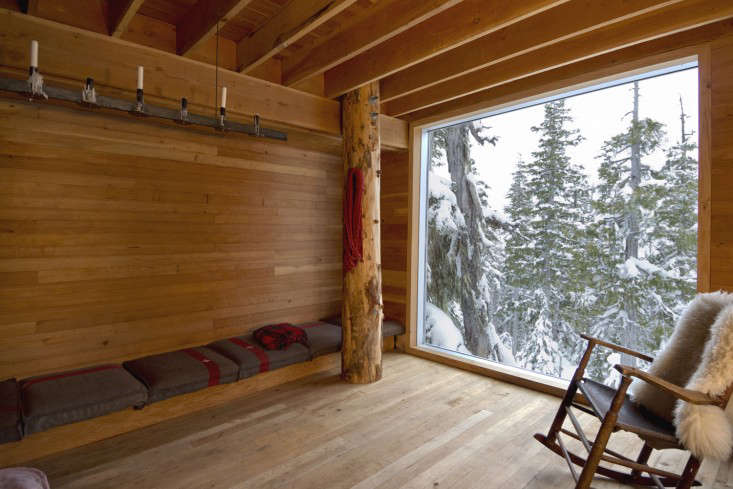
Inside, those columns don’t get hiddenthey’re celebrated, turning structure into sculpture.
The cabin’s large window wall creates that “snow globe” effectan interior that feels both protected and completely immersed in the landscape.
The trick is restraint: instead of adding visual noise, the designers let the forest and snowfall do the decorating.
Off-Grid on Purpose: No Electricity, No Apologies
Plenty of modern “off-grid” homes are really “on-grid, but with solar and a big ego.” This one goes further.
The cabin operates without electricity. That choice isn’t about suffering for aesthetic points; it’s about clarity.
Remove the wiring and you suddenly get a building that’s easier to construct in a remote area, easier to maintain, and less dependent on parts
you can’t replace when a storm turns the road into a myth.
Heat: the wood stove as the literal and emotional center
Heat comes from a wood-burning stovean old solution that remains brilliant when you’re far from utility lines.
A stove isn’t just warmth; it’s a rhythm. You split, stack, dry, and burn. You learn how long a log lasts, how a room holds heat,
and how quickly wet gloves can become “wearable again.” The cabin’s built-in wood storage makes fuel part of the interior architecture:
functional, tidy, and always within reach when the temperature drops.
Practical note: wood heat is cozy, but it’s also a system. The smartest off-grid setups treat the stove like a high-performing appliance, not a campfire.
Clean burning, proper venting, and regular chimney care are what keep “rustic” from turning into “emergency call… if you have service.”
Light: candlelight, but make it architectural
Here’s where Remodelista’s title earns its drama: lighting is candle-based, and the candles aren’t an afterthought.
They’re housed in blackened steel that runs the length of the living roompart light source, part minimalist art installation.
Candlelight is flattering, yes, but it’s also practical in an electricity-free building: no bulbs to burn out, no wiring to troubleshoot,
and the soft glow matches the cabin’s calm, pared-down interior.
The design takeaway is bigger than candles. It’s about choosing one strong idea and doing it well.
Instead of sprinkling tiny lights everywhere, the cabin uses a deliberate, linear gesturesimple, repeatable, and visually grounding.
Water: carried in, used wisely
Water is collected from a local source and brought to the cabinanother “constraint as a feature” decision.
When water arrives by human effort, waste becomes deeply unromantic. You automatically get smarter:
quick rinses, intentional cooking, and the kind of dishwashing that doesn’t involve running a faucet while you stare into space.
It’s not about deprivation; it’s about awareness.
Materials with Backbone: Fir, Cedar, Leather, and Steel
The cabin’s palette reads like a shortlist for “things that age well.” The structure and interior lean heavily into fir:
rough-sawn lumber, planed fir finishes, and those exposed Douglas fir columns. Outside, cedar cladding weathers into a soft silver-gray,
blending into the surrounding woods instead of fighting for attention.
Then come the small moves that make cold-weather life more comfortable. Leather-wrapped door handles are warmer to the touch than bare metal
(your winter fingers will write thank-you notes). Textileslike vintage Swiss Army blankets and a classic Hudson’s Bay blanketbring warmth, history,
and a little pattern without disrupting the minimalist calm.
1,000 Square Feet, Two Stories, Zero Wasted Moves
At around 1,000 square feet, the cabin hits a sweet spot: big enough for real lounging and two bedrooms, small enough to heat efficiently and keep tidy.
The plans are straightforward, but the livability comes from built-ins and purposeful zones.
A carved-out porch area on the ground floor becomes storage for firewood and snowboarding gearbecause wet gear needs a home that is not “the middle of the room.”
The living space is anchored by a built-in bench (the unsung hero of compact cabins), plus integrated wood storage that turns necessity into décor.
The overall feel is minimalist, but not sterilemore “warm timber cocoon” than “museum where you’re afraid to sit down.”
Design Lessons You Can Steal (Even If You Still Love Wi-Fi)
- Design for the harshest day, not the prettiest weekend. Elevate for snow, brace for wind, and assume weather will test every choice.
- Let the structure do the styling. Exposed columns and honest materials beat decorative clutterespecially when you’re cleaning by headlamp.
- Build storage into the architecture. Firewood, boots, and boards need dedicated zones or they will take over like cheerful gremlins.
- Choose one lighting concept and commit. Candlelight can be both functional and beautiful when it’s treated as a real design system.
- Small comforts matter more off-grid. Warm-to-touch handles, good textiles, and a protected gear porch have an outsized impact.
Safety and Reality Checks: Keep the Romance, Skip the Risk
Candles: cozy, yescareless, no
Candlelit living is undeniably magical, but the magic depends on basic habits: stable holders, clear surfaces, and flames kept well away from anything
that can burn. Think of it as “ambience with boundaries.” If you want the vibe without the worry, many off-grid folks pair candles with enclosed lanterns
and keep battery headlamps nearby for tasks that require actual visibilitylike not chopping your thumb while making dinner.
Wood heat: burn clean, breathe easier
Wood stoves are efficient, but they’re still combustion. Dry, seasoned wood burns hotter and cleaner; wet wood creates more smoke and more buildup in the system.
Regular inspection and maintenance help reduce creosote buildup and keep the stove operating safely.
In a remote cabin, a battery-powered carbon monoxide alarm is a non-negotiable modern upgradequiet protection that doesn’t ruin the aesthetic.
Off-grid upgrades (optional, not mandatory)
This cabin proves you can live comfortably without electricity, but many owners who take inspiration from it choose a “tiny power” approach:
a small solar-and-battery setup for charging phones, running a radio, or keeping a few LED lights available for emergencies.
Full off-grid solar systems can be expensive, but scaled-down systems can cover essentials without changing the cabin’s low-tech soul.
of Cabin Experience: What the Photos Don’t Show
Here’s the part glossy design features rarely capture: off-grid life isn’t just a lookit’s a sequence of small, physical experiences that quietly rewire your brain.
You arrive with your city pace still buzzing, and the cabin immediately starts sanding it down. The gravel road does some of that work for you,
shaking out the urge to multitask. By the time you park, your phone has usually stopped being the main character.
In the shoulder season, the cabin feels like a secret you’re allowed to enter. The air smells like wet cedar and cold stone.
You step inside and there’s no switch to flipyour hands instinctively reach for a candle, a lighter, a lantern.
And that tiny pause changes everything. Light becomes an action, not a default. You choose where brightness goes.
You choose where shadows can stay. Suddenly, the room isn’t “lit,” it’s composed.
Then the stove ritual beginsthe cabin’s most honest form of luxury. You stack kindling, coax flame, and feel the first wave of heat
push back against the chill. It’s not instant, which is the point. Warmth arrives in stages: fingers first, then cheeks, then the deep cold
that’s been living in your shoulders all week. The cabin teaches patience with rewards you can feel.
Even cooking shifts. A stew simmering on the stove becomes less “recipe” and more “slow, fragrant proof that you planned ahead.”
Water is where you really notice the reset. If you carried it in, you don’t waste it. You pour like it’s valuablebecause it is.
You rinse a mug with purpose. You wash a pan with the kind of focus that would make your past self whisper, “Who are you?”
And the funny thing is, it doesn’t feel restrictive. It feels… clean. Mentally and literally.
Less running water, less mindless noise, more awareness of what you’re doing and why.
Winter accessthe toboggan seasonadds another layer of storybook practicality. Supplies arrive like a tiny expedition.
Every item is questioned before it earns a spot: Do we need it? Will we use it? Is it worth hauling?
The cabin turns consumption into a deliberate choice, not a reflex. You start to love multi-use objects:
a blanket that’s insulation and décor, a bench that’s seating and storage, a hook that keeps wet gear from becoming a floor problem.
And at night, candlelight does what overhead lighting never can: it slows time.
Conversations stretch out. The window turns into a dark mirror that occasionally flashes with snow.
You hear the wind. You hear the stove tick as it cools. You realize you’re not boredyou’re finally un-distracted.
The cabin isn’t anti-modern. It’s pro-attention. You leave with the strangest souvenir of all:
the memory of being fully present, and the suspicion that you might not need as much as you thought.

