
If you’ve ever walked through a forest and thought, “Wow, look at all these pine trees,” there’s a decent chance
at least a few of them weren’t pines at all. Spruce, fir, hemlock, and cedar all love to photobomb the “pine tree”
group photo. The good news? Once you know a few simple tricks, pine tree identification becomes surprisingly fun
(and a little addictive).
The genus Pinus includes a little over 120 species of evergreen conifers scattered across the Northern
Hemisphere. Some are towering forest giants, others are gnarled high-mountain survivors, and a few are polite
compact shrubs that actually fit in a front yard. This guide walks you through 40 types of pine trees you’re likely
to encounter in North America and in home landscapes, with quick identifying facts you can remember in the field.
We’ll start with a lightning ID lesson, then dive into the species list, and finish with real-world “what it’s
actually like to live with pines” experiences you can steal before you plant a single needle.
Quick Guide to Identifying Pine Trees
Needles and Fascicles: Your First Clue
Pines are the conifers with needles in clusters, not singly attached along the twig. Those clusters
are called fascicles. Most pines carry their needles in bundles of 2, 3, or 5, and that count is
one of the fastest ways to narrow down your species.
- 2-needle pines – Often called “hard pines.” Includes jack pine, red pine, Scots pine, and many southern pines.
- 3-needle pines – Ponderosa, longleaf, loblolly, slash, and several western species.
- 5-needle pines – Typically called “white pines.” Includes eastern white pine, sugar pine, limber pine, and whitebark pine.
Needle length and feel help too. Longleaf pine needles can be over a foot long and stiff; eastern white pine needles
are soft, flexible, and brush-like. Bluish or silvery needles often hint at high-elevation or ornamental species.
Cones, Bark, and Overall Shape
Cones are like name tags for pines. Some species, like sugar pine, grow absurdly long cones that dangle from the ends
of branches. Others, like bristlecone and knobcone pines, carry smaller cones that cling to the tree for years and
may open only after fire. Southern pines often have prickly cone scales; many high-elevation pines have more rounded,
resinous cones.
Bark and silhouette finish the picture. Ponderosa pine develops puzzle-piece plates that smell faintly of vanilla or
butterscotch when warmed by the sun. Red pine bark tends to be flaky and reddish, while eastern white pine bark turns
dark gray and deeply furrowed with age. Some pines grow narrow and columnar; others spread into broad, umbrella-like
crowns perfect for shade.
40 Types of Pine Trees (and How to Recognize Them)
Below is an easy-skim list of 40 pine tree species. For each one, you’ll see its common and scientific name, plus
at least one fast identifying fact and a hint about where you’ll find it.
-
Eastern White Pine (Pinus strobus) – Soft blue-green needles in bundles of five (think the five letters in “white”);
long, slender cones and a tall, straight trunk. A dominant forest tree across the northeastern U.S. and Great Lakes. -
Western White Pine (Pinus monticola) – Another 5-needle pine with soft, bluish needles, but native to the Pacific
Northwest and northern Rockies. Cones are long and slightly curved; trees favor cool, moist mountain slopes. -
Sugar Pine (Pinus lambertiana) – The drama queen of pines, bearing the longest cones in the world, often 14–24 inches.
Needles in fives and a tall, straight trunk identify this Sierra Nevada icon. -
Ponderosa Pine (Pinus ponderosa) – Tall, straight western pine with yellow-brown puzzle-piece bark plates and
3-needle bundles. Crush and sniff the bark on a warm day; many people smell vanilla or butterscotch. -
Jeffrey Pine (Pinus jeffreyi) – Looks like ponderosa but usually higher in elevation with heavier, more inward-curved cone
prickles. Needles are in bundles of 3; cones are big and sturdy. -
Lodgepole Pine (Pinus contorta) – Slim, straight trunk (once used for lodge poles), short paired needles, and small,
often closed cones that may open after fire. Common in the Rockies and Pacific Northwest. -
Shore Pine (coastal form of Pinus contorta) – A coastal twist on lodgepole; often crooked, wind-sculpted trunks and
dense foliage. Thrives in salty, windy, poor soils along the Pacific Coast. -
Jack Pine (Pinus banksiana) – Scrappy northern pine with 2 short, curved needles per bundle and small, tightly sealed
cones that open with heat. Key species in sandy, fire-prone boreal forests. -
Red Pine (Pinus resinosa) – Tall, straight trunk with reddish flaky bark; 2 medium-length needles that snap cleanly when
bent. Form tidy, even stands in the upper Midwest and Northeast. -
Scots (Scotch) Pine (Pinus sylvestris) – European native widely planted in North America. Orange, peeling bark on the
upper trunk, paired twisted needles, and small, egg-shaped cones; a classic old-school Christmas tree. -
Austrian (Black) Pine (Pinus nigra) – Dense, dark green needles in pairs and thick, rugged bark. Popular as a windbreak
and urban street tree thanks to its toughness and salt tolerance. -
Monterey Pine (Pinus radiata) – Fast-growing coastal California native with long, dark needles and large, woody cones that
can persist for years. Globally famous as a plantation tree, but wild stands are limited. -
Gray (Foothill) Pine (Pinus sabiniana) – Bluish-gray foliage and wide-spreading, open crown in California’s foothills.
Bears large, heavy cones and prefers hot, dry, rocky slopes. -
Limber Pine (Pinus flexilis) – High-elevation 5-needle pine with flexible branches you can gently bend (hence the name).
Often windswept, living on exposed ridges in the Rockies and Great Basin. -
Whitebark Pine (Pinus albicaulis) – Rugged, high-mountain 5-needle pine with pale bark and clusters of branches forming
a krummholz (low, shrubby) shape near treeline. Its large seeds are a favorite of Clark’s nutcrackers. -
Foxtail Pine (Pinus balfouriana) – Rare California high-elevation species with dense tufts of needles at branch tips
that resemble fox tails. Bark is reddish and furrowed; trees often sculpted by wind and snow. -
Great Basin Bristlecone Pine (Pinus longaeva) – Famous for being among the oldest living trees on Earth. Needles in groups
of 5, tiny bristled cone scales, and twisted, weathered trunks in dry, cold mountain sites. -
Singleleaf Pinyon (Pinus monophylla) – The only pine with mostly single needles instead of bundles. Short, stout needles
and small, edible seeds; a dominant tree of Great Basin pinyon–juniper woodlands. -
Mexican Pinyon (Pinyon Pine) (Pinus cembroides) – Multi-needle bundles (usually 2–3), compact rounded crown, and large,
oily seeds harvested as pine nuts in the Southwest. -
Loblolly Pine (Pinus taeda) – One of the most widespread southern pines. Long, 3-needle bundles, tall straight trunk,
and dull brown cones with sharp prickles; common in plantations and second-growth forests. -
Longleaf Pine (Pinus palustris) – Super-long, fountain-like needles (up to 18 inches) in bundles of three and very large
cones. Young trees spend years in a “grass stage” before rocketing upward; historic backbone of southern pine savannas. -
Slash Pine (Pinus elliottii) – Southern pine of wetter sites, with 2–3 needles per bundle and glossy caramel-colored cones.
Often planted in plantations and along highways in the Southeast. -
Shortleaf Pine (Pinus echinata) – Medium-sized pine with relatively short needles in pairs and small, prickly cones.
Look for irregular plates of bark with tiny resin pockets on mature trunks. -
Virginia Pine (Pinus virginiana) – Scrubby, often crooked stems and short, twisted needles in pairs. Cones are small and
persistent; common on poor, dry sites in the mid-Atlantic and Appalachians. -
Pitch Pine (Pinus rigida) – Known for sprouting new shoots directly from its trunk and branches after fire. Needles in
bundles of three and rough, dark bark; a staple of northeastern sandy barrens. -
Table Mountain Pine (Pinus pungens) – Appalachian specialist with stout cones armed with thick, curved prickles. Needles
in pairs or threes; trees often leaning or contorted on rocky ridges. -
Sand Pine (Pinus clausa) – Florida and Gulf Coast pine adapted to extremely sandy soils. Short needles in pairs and
cones that may remain closed for years, opening after fire. -
Pond Pine (Pinus serotina) – Southern pine of wet, boggy sites. Needles in clusters of 3 and cones that often remain on
the tree for several years, sometimes opening after fire; bark is rough and reddish-brown. -
Spruce Pine (Pinus glabra) – Shade-tolerant southern pine with relatively short, dark green needles and smoother bark
than most pines. Often mixed into hardwood forests rather than open pine stands. -
Coulter Pine (Pinus coulteri) – Bears enormous, heavy cones nicknamed “widow-makers.” Needles are long and gray-green,
branches spreading in open crowns across dry slopes of coastal California mountains. -
Torrey Pine (Pinus torreyana) – One of the rarest pines in North America, naturally occurring only near San Diego and on
Santa Rosa Island. Large, thick needles in bundles of five and heavy cones; wind-twisted seaside silhouettes. -
Mugo Pine (Pinus mugo) – Compact, multi-stemmed shrub pine from European mountains. Short, dark needles and squat cones;
an all-star dwarf pine for rock gardens, foundations, and containers. -
Japanese Black Pine (Pinus thunbergii) – Dramatic, dark-needled pine often used in coastal landscapes and bonsai. Thick,
rugged bark and irregular, architectural branching give it strong visual character. -
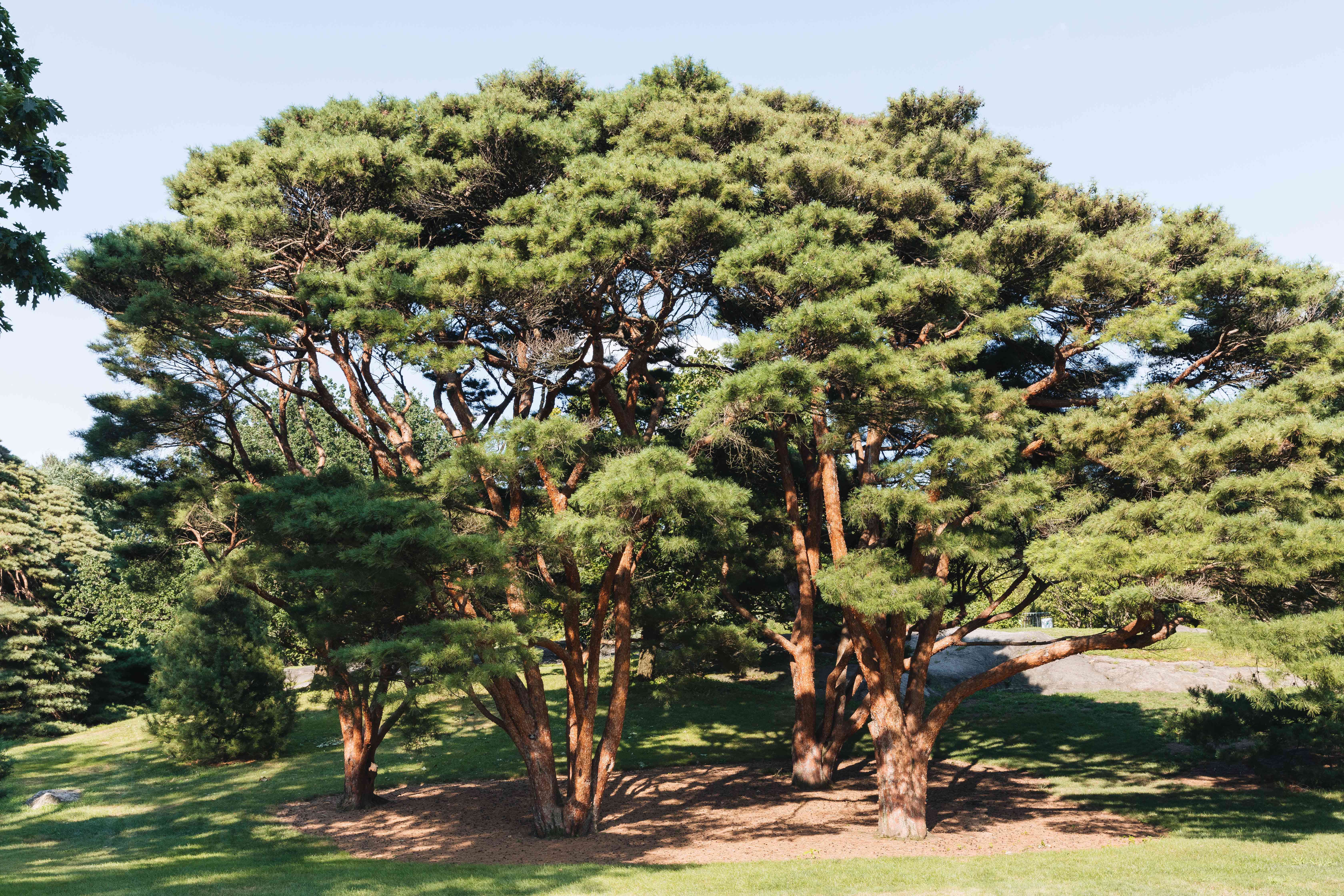
Japanese Red Pine (Pinus densiflora) – Graceful, open crown with reddish bark and fine, airy needles. Frequently used in
Asian-inspired gardens and as a specimen tree. -
Aleppo Pine (Pinus halepensis) – Mediterranean pine adapted to heat, drought, and poor soils. Irregular crown, long
slender needles, and small, curved cones; sometimes planted in warm, dry U.S. regions. -
Italian Stone Pine (Pinus pinea) – Famous for its umbrella-shaped crown and edible pine nuts. Thick trunk, relatively
short needles in pairs, and rounded canopy make it a dramatic landscape tree in warm climates. -
Swiss Stone Pine (Pinus cembra) – Slow-growing, narrow-crowned 5-needle pine with soft, bluish needles and dense foliage.
Tolerant of cold; prized as an ornamental and for its edible nuts. -
Korean Pine (Pinus koraiensis) – East Asian white pine with long, soft 5-needle bundles and large cones that produce
big pine nuts. Sometimes planted as a nut or ornamental tree in colder regions. -
Bhutan (Himalayan White) Pine (Pinus wallichiana) – Elegant drooping needles up to a foot long give this tree a weeping
look. A high-altitude Himalayan species occasionally used as an ornamental in cool climates. -
Canary Island Pine (Pinus canariensis) – Tall, slender pine highly tolerant of drought and even lava flows in its native
Canary Islands. Long, graceful needles and deeply furrowed bark; sometimes used in warm-climate landscaping.
Real-World Experiences with Pine Trees
Knowing the names and needle counts is one thing. Living with pine trees day to day is another story entirely.
Homeowners, hikers, and foresters all notice different “personality traits” that don’t always show up in botany
textbooks.
In a yard or garden, pines are usually loved first for their evergreen privacy. A row of Austrian or
loblolly pines can muffle road noise, hide a neighbor’s second-story deck, and keep your landscape green even when
everything else goes brown and dormant. That said, the same trees also drop a lot of needles and cones.
Under tall pines, lawns often thin out and are replaced by a soft, rust-colored carpet of needles. Many people simply
lean into it and turn that space into a shady sitting area, mulch bed, or woodland garden instead of fighting for
turf grass.
If you like wildlife, pine trees are basically a year-round buffet. Pinyons and stone pines feed birds, squirrels,
and people with nutritious seeds. Longleaf and loblolly stands provide crucial cover for quail, turkeys, and deer.
High-elevation pines like whitebark and limber are literal life-support systems for Clark’s nutcrackers and other
alpine species. Watching how quickly animals find and strip a fresh cone can be a fun reminder that your trees are
part of a much larger food web.
There are also some very practical “experience” lessons that pine owners learn quickly:
-
Site matters. Longleaf pine sulks in heavy clay but thrives in deep, sandy soils. Shore pine
handles salty coastal winds that would shred more delicate trees. Choosing a pine that matches your climate and
soil saves years of frustration. -
Needles are free mulch. Pine needles (often sold as “pine straw”) make an excellent, long-lasting
mulch for paths, vegetable beds, and especially acid-loving plants like blueberries, azaleas, and rhododendrons. -
Think about scale. That cute 6-foot eastern white pine sapling can easily hit 60–80 feet with a
broad canopy. Plant large species well away from foundations, overhead lines, and small patios; use dwarf pines
like mugo for tight spaces. -
Fire ecology is real. Many pine forests evolved with periodic fire. In fire-prone regions,
thinning, pruning lower branches, and managing ground fuels around structures is just as important as proper
species selection.
On hiking trails, pines become landmarks in your mental map. A lone ponderosa with fragrant bark, a cluster of
bristlecones twisted into ancient sculptures, or a whitebark pine clinging to a crag at treeline can mark a favorite
viewpoint or campsite. Once you can recognize different pine silhouettes from far away, a mountainside stops being a
wall of green and turns into a patchwork of species, each telling you something about elevation, soils, and fire
history.
Whether you’re planting one pine in a backyard or wandering through thousands of them on public land, paying
attention to needles, cones, bark, and “vibes” adds a whole new layer of enjoyment. The species list you just read
isn’t just triviait’s a toolbox for seeing more detail in every forest you visit.
Conclusion
Pine trees may all look similar from a distance, but up close they’re wonderfully diverse. By counting needles in a
bundle, checking cone size and texture, and studying bark and shape, you can quickly separate white pines from hard
pines, southern species from western high-elevation specialists, and dwarf garden pines from towering forest trees.
Use this guide as a starting point: pick a handful of species you’re likely to see where you live, practice
identifying them, and then add more over time. Before long, “just some pines” will turn into a cast of familiar
characters with names, habits, and stories you recognize at a glance.