
Getting a cell phone ticket in California can feel like paying a “because I said so” tax.
The good news: you often have legitimate ways to challenge itespecially if the officer’s
observation was shaky, the wrong code section was used, or your setup actually fits within
the hands-free rules.
This guide breaks down four practical strategies (with examples) that real people use to fight
California cell phone citations. It’s written in plain English, with just enough legal detail to
keep you out of troubleand not so much that your eyes glaze over like you’re reading your
car’s extended warranty.
Quick disclaimer: This is general information, not legal advice. For a specific case, consider a licensed California traffic attorney.
California cell phone tickets: the 90-second primer
Most California “cell phone tickets” fall under two common Vehicle Code sections:
-
VC 23123: Using a wireless phone while driving unless it’s hands-free for
listening and talking. It includes an emergency-use exception (think calling law enforcement,
a medical provider, fire department, etc.). It also doesn’t apply on private property. -
VC 23123.5: Holding and operating a handheld wireless phone or electronic
wireless communications device while driving unless it’s voice-operated and hands-free.
There’s a key carve-out: you may touch the device only if it’s mounted properly and
you’re activating/deactivating a function with a single swipe or tap.
Two more “gotchas” matter in 2026:
-
Repeat offenses can add a DMV point. Under VC 12810.3, a point is assessed
only for a distracted-driving conviction occurring on/after July 1, 2021, that occurs within
36 months of a prior conviction for the same offense (including 23123 and 23123.5). -
Holding your phone to view a map can still be a violation. In 2025,
California’s Sixth Appellate District interpreted “operating” under VC 23123.5 broadly
enough to include holding and viewing a mapping application while driving.
Penalties vary by county and fees, but the base fine is typically $20 for a first offense
and $50 for subsequent offenses (the real out-the-door total is often much higher once assessments
are added). Even the CHP has warned that a first citation can cost a minimum in the $160 range.
That’s a lot of money for the privilege of being scolded on paper.
Way 1: Challenge whether the law even fits your situation
The fastest path to winning is showing the court that the facts on your ticket do not satisfy the
legal elements of the section you’re charged under. In other words: “Even if you believe the officer,
the statute still doesn’t fit.”
Step 1: Identify the exact code section on your citation
Don’t assume “cell phone ticket” automatically means texting. In practice, people get cited under
23123, 23123.5, or (for minors) 23124. The defense changes depending on the section.
Step 2: If it’s VC 23123.5, focus on “holding” and the mounted-device exception
Under VC 23123.5, the prosecution generally needs to show you were holding and operating
the device while driving. Your strongest factual defenses often look like this:
-
“I wasn’t holding it.” Example: your phone was mounted on the dashboard/center console/windshield
(without blocking your view), and you used voice commands. -
“If I touched it, it was one swipe/tap to activate or deactivate a feature.”
This is the specific carve-out written into 23123.5but only if the device is mounted properly. -
“The officer couldn’t actually see what they claim.” If you were stopped at night, behind tinted glass,
or the officer was at an angle, you may be able to argue mistaken observation (more on evidence in Way 2).
Step 3: If it’s VC 23123, check for an emergency-purpose defense (and other exclusions)
VC 23123 has specific language about emergency use and other exclusions that can matter in edge cases.
If you were making an emergency call (or responding to a genuine emergency), this may be a legitimate defense.
Also note: 23123 explicitly does not apply on private property, which occasionally matters in parking lots and private roads.
Step 4: Don’t fight yesterday’s battleknow the modern interpretation
Many drivers still think “If I’m not texting, I’m fine.” Not necessarily. A 2025 appellate decision interpreted
“operating” under VC 23123.5 broadly enough that holding a phone while viewing a mapping application can qualify.
Translation: if the phone is in your hand while you’re driving, your defense should not rely on
“I was only looking at directions” unless you have a stronger statutory angle (like proper mounting + single tap).
Mini takeaway: The law is picky. Use that. Your job is to show the court a clean mismatch:
the statute says A + B + C, and your situation is missing at least one of those letters.
Way 2: Build an evidence packet that creates reasonable doubt
Traffic cases are often “officer says / driver says.” When you bring receiptsphotos, diagrams, call logs,
and a calm timelineyou stop being “a person with an opinion” and become “a person with exhibits.”
Judges like exhibits.
Evidence ideas that work especially well for cell phone tickets
-
Photos of your interior setup (phone mount location, dashboard layout, visibility).
Pro tip: take pictures from the driver’s seat and from outside angles similar to where an officer might have been. -
Navigation screenshots or settings showing voice guidance enabled, “Do Not Disturb While Driving,”
or hands-free features turned on. - Call and message logs for the time window (not to overshare your lifejust to support “no call/text happening then”).
-
Dashcam footage (if you have it). Even 10 seconds can be powerful if it shows both hands on the wheel
or the phone mounted. - Witness statements from a passenger, if present. Keep them short, specific, and signed.
Build a timeline that makes the officer’s story feel unlikely
Your written or spoken defense should be structured like a simple story:
- Where you were (street/highway, direction of travel).
- What your phone was doing (mounted navigation, voice commands, not in hand).
- What your hands were doing (steering, signaling, stopping at light).
- Why the observation could be mistaken (angle, glare, night, traffic, tinted windows, distance).
Example: Turning a “gotcha” stop into uncertainty
Imagine the officer writes: “Driver was holding phone to face and talking.” You respond:
- You show a photo of a mounted phone position on the center console.
- You explain your car’s Bluetooth was connected and voice calls route automatically.
- You include a call log showing no active call at that time (or that any call was routed hands-free).
- You note the officer was behind you at night with heavy traffic and could not see the center console clearly.
You’re not calling the officer a liaryou’re giving the court a reasonable alternative explanation.
That’s how you win without sounding like a comment section.
Mini takeaway: Your goal isn’t to deliver a dramatic monologue. It’s to make the court say,
“I’m not confident this citation was proven.”
Way 3: Use a Trial by Written Declaration (TR-205) like a pro
If you want to fight the ticket without taking a day off work, California lets you contest many traffic citations
in writing through a Trial by Written Declaration using form TR-205.
You submit your statement and evidence, the officer submits theirs, and a judge decides.
Why this option is so popular
- You can fight the ticket without appearing in person (in many cases).
- You have time to write clearly instead of improvising under fluorescent courtroom lighting.
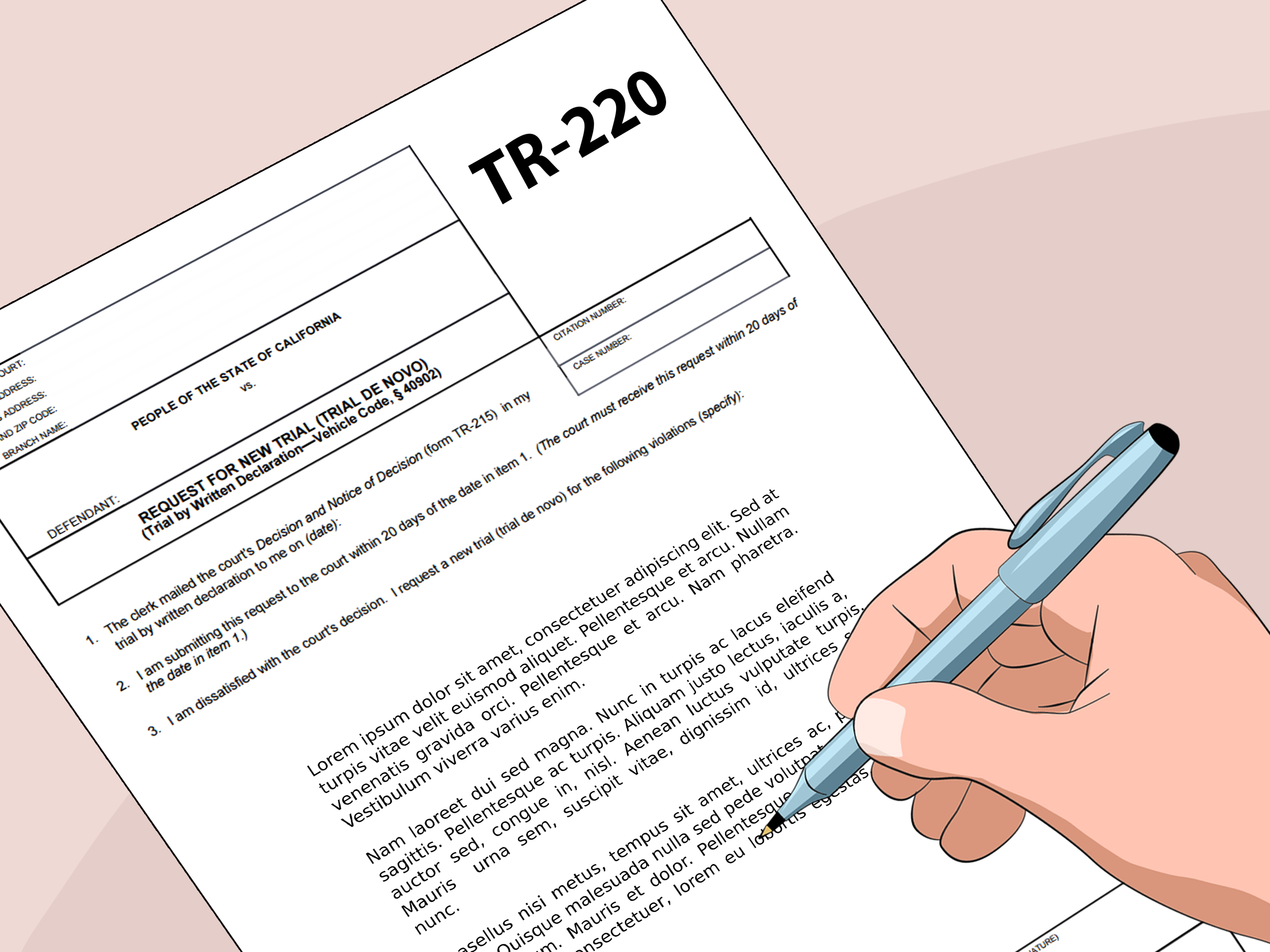
- If you lose, you may be able to request a brand-new in-person trial (a “trial de novo”)depending on the process you used.
How the process works (high-level)
- Get your court’s instructions (deadline, bail amount, submission method).
- Complete TR-205 and attach your statement and evidence (photos, diagrams, witness statements).
- Pay the bail when you submit your packet (the court holds it during review).
- The court requests the officer’s statement, then a judge decides based on both sides.
-
If you win, bail is refunded (all or part, depending on the decision).
If you lose, you may be able to request a new trial (trial de novo) within the required deadline.
How to write a winning declaration (the simple template)
Your declaration should read like a well-organized report, not a rant. Use headings:
- Statement of Facts: What happened, in chronological order, with neutral language.
- Legal Fit: Identify the code section and explain which element is not met (e.g., not holding; mounted + single tap; hands-free).
- Evidence List: “Exhibit A: Photo of mounted phone; Exhibit B: dashcam still; Exhibit C: witness statement,” etc.
- Closing: A short, respectful request: dismissal, or reduction if the court finds partial fault.
Pro tips that actually matter
- Be brief, not vague. Short sentences. Concrete facts. No sarcasm aimed at the officer.
- Match your evidence to your argument. If your defense is “mounted phone,” include the mount photo. Always.
- Know the “trial de novo” rule. Some online systems can limit your ability to get a brand-new trial later. Read your court’s instructions carefully.
Mini takeaway: A written declaration is your chance to make the judge’s job easy:
“Here is the rule, here are the facts, here are the exhibits, here is why it doesn’t add up.”
Way 4: Fight it in court (and cross-examine politely)
If you choose an in-person court trial (or you request a trial de novo after losing a written declaration),
you get something powerful: the ability to question the evidence live and highlight inconsistencies.
The secret sauce here is preparationnot volume.
What “winning in court” usually looks like
- The officer’s memory is thin. Time passes; notes are limited; details blur.
- The observation conditions were poor. Angle, distance, glare, traffic, window tint, nighttime lighting.
- The officer can’t clearly explain “holding and operating.” Especially if your phone was mounted or your hands were visible.
- Your evidence is clean and consistent. Photos match your story; your story matches the citation details; nothing contradicts itself.
Smart questions to ask (without sounding like you binge-watched courtroom dramas)
Your goal is to narrow the claim until it becomes uncertain. For example:
- “Where were you positioned relative to my vehicle when you observed the alleged violation?”
- “What was the lighting and traffic condition?”
- “How far away were you?”
- “Which hand was I allegedly using?”
- “Did you observe screen interaction, or only that an object was in my hand?”
- “Could the object have been something else (wallet, receipt, sunglasses)?”
Use the law as a scalpel, not a sledgehammer
Courts are busy. If your defense hinges on a specific statutory exceptionlike a properly mounted device and
a single swipe/tap to activate a functionbring a photo of the mount and explain that exact sequence:
“mounted, one tap to start navigation, hands back on the wheel.”
Consider a traffic attorney when the downside is bigger
Many first-time cell phone tickets are about money and hassle. But if you’re facing a point issue (repeat offense within 36 months),
commercial driving consequences, or a complicated fact pattern, a traffic attorney may be worth the cost.
Think of it as paying someone else to speak Fluent Courtroom.
Mini takeaway: In person, you win by being the most organized adult in the room.
(Low bar sometimes, but still.)
Common mistakes that sink good defenses
- Admitting too much. “I picked it up, but only for a second!” can be enough to lose under 23123.5.
- Arguing feelings instead of facts. “The ticket is unfair” is not a defense. “The phone was mounted; here’s a photo” is.
- Missing deadlines. Courts love rules. Miss one, and you may lose without ever being heard.
- Sending a novel. Judges appreciate clarity. Aim for a short declaration with labeled exhibits.
- Relying on outdated internet advice. The interpretation of “operating” has evolved; don’t build a defense on old assumptions.
FAQ: Quick answers people actually want
Is it illegal to touch my phone at all while driving in California?
Not always. Under VC 23123.5, you may use your hand only if the device is properly mounted and you’re activating/deactivating a function
with a single swipe or tap. If the phone is in your hand, you’re in far riskier territory.
Will a cell phone ticket add points to my driving record?
A point is generally tied to repeat convictions within 36 months for the same offense under VC 12810.3 (for qualifying distracted-driving convictions
occurring on/after July 1, 2021). If you’ve had a prior conviction recently, take this seriously.
What’s the easiest way to fight a ticket without going to court?
A Trial by Written Declaration (TR-205) is a popular option if your court allows it and your case is eligible. You submit your defense in writing,
include evidence, and the judge decides.
Can I get the ticket dismissed if I say I was only using GPS?
“Only GPS” isn’t an automatic get-out-of-ticket card, especially if the phone was in your hand. A stronger approach is showing your phone was mounted
and you used voice guidance (or you fall within a specific statutory exception).
Conclusion: Fight smarter, not louder
A California cell phone ticket isn’t unbeatable. The most successful challenges usually do one of three things:
(1) show the statute doesn’t match the facts, (2) create reasonable doubt with clean evidence, or (3) use the court’s processlike TR-205
to present a clear, organized defense.
Pick the approach that fits your situation, meet every deadline, and keep your argument focused on verifiable facts.
That’s how you give yourself the best shot at paying $0 instead of paying $162+ for the privilege of being annoyed.
Extra : Real-world-style experiences & lessons from fighting CA cell phone tickets
The following are composite experiencesthe kinds of situations drivers commonly describe when contesting cell phone citations.
They’re not promises of results, but they highlight patterns that can help you avoid the usual landmines.
Experience #1: “I was just holding it for GPShow is that illegal?”
This is the most common emotional starting point. A driver gets pulled over, confused, because they weren’t texting or calling.
They were simply holding the phone with maps open. The key lesson is that California’s rules focus heavily on handheld use,
and courts may treat “operating” broadlyespecially under VC 23123.5. The drivers who do best in this scenario don’t lean on
“but I wasn’t typing!” as a defense. Instead, they pivot to what the law actually rewards:
mounting, voice guidance, and the “single tap” exception when properly mounted.
In practical terms, people who win these cases often bring a photo of their mount (or install one immediately and show it),
then explain a consistent routine: phone stays mounted, navigation is started before moving, and any adjustment is a single tap
while mounted. Drivers who lose often admit the fatal detail: “Yeah, it was in my hand.”
Experience #2: The “I wrote a masterpiece” TR-205 that lost anyway
A lot of drivers assume a Trial by Written Declaration is a creative writing contest. They submit pages of frustration,
sarcasm, and capital letters. The court responds with the legal equivalent of: “Cool story, still guilty.”
The winning shift is simple: treat TR-205 like a mini report.
Drivers who get better outcomes usually do three things:
- They write fewer words, but each sentence contains a fact the judge can rely on.
- They label exhibits (Exhibit A, B, C) and explicitly connect each exhibit to an element of the statute.
- They avoid arguments about motive (“Officer was targeting me”) and focus on proof (“Officer couldn’t see into the cabin from that angle”).
The most “boring” declarationsclear, polite, evidence-driventend to be the most effective.
Experience #3: The officer’s angle mattered more than the driver expected
Many contested tickets hinge on whether the officer could truly observe “holding and operating” versus merely seeing
a driver glance down or hold something. Drivers frequently report that when they diagram the scenelanes, distance,
the officer’s position, the time of daythe observation becomes less certain.
One common pattern: a stop at dusk or nighttime, where the interior is dark and the officer is behind and offset.
The driver who wins doesn’t say “Impossible!” They say: “Given your position and lighting, it’s easy to mistake a mounted device
or another object for a phone in-hand.” Then they support it with photos taken from similar angles. That’s not confrontation; it’s logic.
Experience #4: Court was shorter than expectedand preparation was everything
People imagine traffic court like TV. In reality, it can be fast. The drivers who feel successful afterward usually had
a short checklist:
- They knew the exact code section and what it requires.
- They had 2–3 key points, not 20.
- They had printed evidence (or approved digital evidence) ready to show.
- They asked simple, non-argumentative questions about the officer’s position and observations.
The drivers who feel steamrolled usually tried to “explain everything.” In traffic court, “everything” can sound like “nothing.”
The more focused you are, the more credible you seem.
Experience #5: The unexpected “bonus” lessonfix your setup immediately
Even when people don’t win, many walk away with the same practical lesson: if you’re going to use navigation or music,
mount your phone properly and rely on voice features. Not just to avoid tickets, but to avoid the split-second distraction
that creates real danger. Ironically, the best long-term “defense” is making sure you never have to defend yourself again.
Bottom line: Successful challenges usually aren’t about clever loopholes. They’re about matching the facts to the statute,
documenting what you can prove, and presenting it in a way a judge can process quickly.