
SaaStr Scale 2021 packed an impressive amount of B2B SaaS wisdom into fast-paced, 20-minute virtual sessions. Among the dozens of talks, four marketing sessions stood out as a mini-MBA in how to scale revenue in a world of product-led growth, AI-powered finance, low-code platforms, and growth-obsessed teams.
In this guide, we’ll unpack the big ideas from:
- Reprise’s VP of Marketing and VP of Sales on full-funnel product-led growth
- Tipalti’s CMO on building a scalable growth engine on top of finance automation
- Airtable’s CMO on creating marketing foundations for explosive customer acquisition
- Guru’s VP of Marketing on building a truly growth-oriented team
Think of this as your highlight reel plus playbook: what they said, why it matters, and how you can steal the best ideas for your own SaaS marketing strategy.
Why These 4 SaaStr Scale 2021 Marketing Sessions Matter
SaaStr Scale is laser-focused on one thing: helping SaaS companies grow revenue faster and more efficiently. The four sessions we’re exploring here hit the most pressing questions modern marketing leaders face:
- How do you make product-led growth (PLG) work across the entire funnel, not just free trials?
- How do you use finance automation and revenue operations as a story, not just a back-office function?
- How do you position a low-code platform so it’s not “just another tool,” but the backbone of modern work?
- How do you build a growth team that experiments relentlessly without becoming total chaos?
The speakersmarketing and sales leaders from Reprise, Tipalti, Airtable, and Guruoperate at the intersection of high-growth SaaS, product-led experimentation, and data-driven decision-making. Their lessons apply whether you’re at $1M ARR or racing past $100M.
Session 1: Full-Funnel Product-Led Growth with Reprise’s VP of Marketing and VP of Sales
Reprise sells interactive demo software that lets revenue teams capture their product and turn it into customizable demo environments for sales, marketing, and customer success. That alone makes them a natural PLG story: their product literally exists to improve conversion across the funnel.
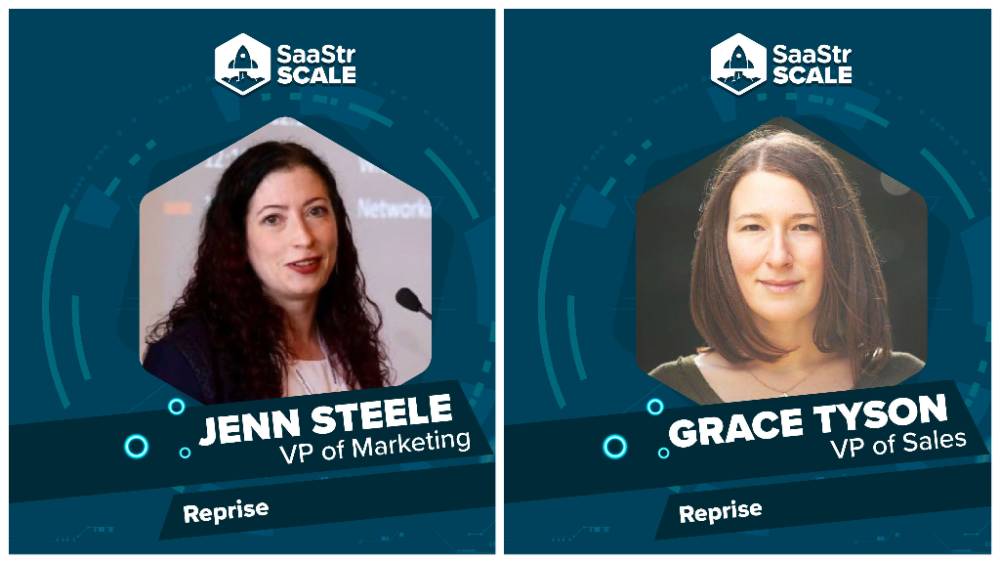
At SaaStr Scale 2021, Reprise’s VP of Marketing, Jenn Steele, and VP of Sales, Grace Tyson, dug into how to execute product-led growth across the full funnel, along with some honest mistakes they made along the way.
Key lessons from the Reprise PLG session
-
PLG is a go-to-market strategy, not a growth hack.
The Reprise team emphasized that PLG goes far beyond slapping a “Free trial” button on your homepage. Product-led growth means the product experience is central to acquisition, onboarding, expansion, and even churn prevention. That impacts pricing, packaging, UX, sales motions, and customer success.
-
Interactive product experiences belong at the very top of the funnel.
Instead of hiding the product behind “Book a demo” forms, Reprise showed how demo environments can power:
- Click-to-launch demos in paid ads and content campaigns
- Interactive product tours embedded in blog posts or comparison pages
- Personalized demos for outbound sequences, tailored by industry or role
The result: prospects get to feel the product quickly, which shortens sales cycles and makes every conversation more concrete.
-
Marketing and sales must share PLG metrics.
Instead of arguing over MQLs vs. SQLs, Reprise focused on metrics like:
- Product-qualified leads (PQLs) and accounts (PQAs)
- Onboarding and activation rates (time-to-value)
- Expansion and upsell driven by product usage signals
When both teams obsess over the same product usage milestones, friction drops and experimentation gets easier.
-
Mistakes are guaranteedjust fail in small, measurable ways.
PLG requires constant experimentation: new onboarding flows, pricing tests, packaging tweaks, and in-product prompts. The Reprise team stressed the importance of rapid experimentation with clear hypotheses and success metrics, instead of giant quarterly “big-bang” launches.
How to apply the Reprise playbook
- Audit where your product shows up in the funnel today (ads, landing pages, sales outreach, customer marketing).
- Build at least one self-serve product experience: a guided tour, sandbox, interactive demo, or freemium tier.
- Align sales and marketing on a shared PLG scorecard: PQLs, activation rate, time-to-first-value, expansion revenue.
- Commit to a quarterly PLG experiment roadmap instead of one-off “projects.”
Session 2: Tipalti CMO on Turning Finance Automation into a Growth Story
Tipalti is a finance automation platform specializing in accounts payable (AP) automation and global mass payments. It helps scaling companies streamline invoice processing, tax compliance, supplier onboarding, and cross-border payments so they can grow without adding endless headcount in finance.
At SaaStr Scale 2021, Tipalti’s CMO shared how to make something that sounds “back-office” feel like a front-of-house growth driverand how to turn complex financial workflows into clear, compelling marketing.
Key lessons from the Tipalti marketing session
-
Tell the growth story, not the feature list.
Instead of leading with jargon, Tipalti focuses on outcomes that matter to CFOs and controllers:
- Closing the books faster
- Scaling to more invoices and suppliers without new hires
- Reducing errors and compliance risk
The CMO’s core message: every feature has to be connected to time saved, risk reduced, or growth unlocked.
-
Category leadership requires proof, not just branding.
Tipalti backs up its category narrative with:
- Concrete metrics (payment volume processed, countries and currencies supported, customer retention rates)
- Logos and case studies from fast-growing companies
- Analyst recognition and awards in fintech and AP automation
That proof gives marketing campaigns credibility when they claim Tipalti helps finance teams become strategic growth partners.
-
Marketing and finance ops are secret best friends.
A fun but important point: when finance is automated and data is clean, marketing can spend smarter. Accurate vendor data, fast approvals, and clear ROI reporting make it easier to double down on profitable channels and shut off wasteful ones.
-
Thought leadership works best when it’s painfully practical.
Tipalti invests in research-backed content on topics like AP automation, NetSuite integrations, and global payments. The best pieces walk through real workflows, before-and-after scenarios, and checklists finance leaders can use immediatelynot just high-level opinions.
How to apply the Tipalti playbook
- Translate every major feature into a growth or efficiency outcome.
- Arm your sales team with quantified stories: “X% faster close,” “Y fewer payment errors,” “Z fewer headcount required to scale.”
- Partner with your finance team to create content around budgeting, ROI, and process optimization.
- Use customer stories to show how operational improvements unlock strategic initiatives (new markets, new lines of business).
Session 3: Airtable CMO on Building Marketing Foundations for Rapid Growth
Airtable is an AI-native, low-code platform that lets teams build custom apps, workflows, and databases without traditional engineering. Marketing teams love it because it combines the familiarity of spreadsheets with the power of a flexible app platform.
At SaaStr Scale, Archana Agrawal, Airtable’s CMO, focused on how to build the foundations for rapid customer acquisition in a category where everyone claims to be “no-code,” “flexible,” and “powerful.”
Key lessons from the Airtable marketing session
-
Operational rigor is a growth lever, not a buzzword.
Airtable’s marketing organization treats operations like product teams treat engineering: with roadmaps, SLAs, and clear ownership. They invest heavily in:
- A unified view of the customer journeyfrom first touch to renewal
- Standardized campaign processes, briefs, and measurement frameworks
- Clear definitions of handoffs between marketing, sales, and customer success
This rigor lets them ship campaigns faster and experiment without creating chaos.
-
Customer focus must be uncomfortably specific.
Airtable doesn’t just target “knowledge workers.” It segments by teams and use cases: marketing operations, content production, product roadmapping, sales enablement, and more. For each, they highlight:
- A relatable “before Airtable” pain (spreadsheets everywhere, siloed tools, messy approvals)
- A clear “after Airtable” outcome (automated workflows, shared views, faster launches)
That specificity makes campaigns feel tailored, not generic.
-
Low-code and no-code are about empowerment, not just tech.
Airtable’s positioning emphasizes the “no-code marketer” and “citizen developer.” The message: you don’t have to wait for engineering to build the tools you need; you can create them yourself. That’s a powerful emotional hook for modern marketers under constant pressure to move faster with fewer resources.
-
Community and templates are core to adoption.
Airtable invests in templates, showcases, and community content that let users copy proven workflows in minutes. That reduces time-to-value and turns power users into advocates who share their bases, dashboards, and automations with others.
How to apply the Airtable playbook
- Clarify your top 3–5 primary use cases and build messaging, demos, and content around each.
- Invest in marketing operations: standardize processes, define ownership, and centralize data.
- Highlight how your product empowers non-technical users to ship faster and own outcomes.
- Create templates, playbooks, or blueprints customers can adopt quickly to experience value in days, not months.
Session 4: Guru’s VP of Marketing on Building a Growth-Oriented Team
Guru is a knowledge management platform that helps go-to-market teams capture, organize, and surface information where they work. That alone makes it a natural home for data-driven, experiment-heavy growth teams.
In the SaaStr Scale session, Brittany Bingham, then VP of Marketing at Guru, explored how to build a growth-oriented teamthe kind of team that doesn’t just ship campaigns but relentlessly hunts for revenue-impacting experiments.
Key lessons from the Guru growth-team session
-
Start with a clear growth model.
A growth-oriented team needs a shared understanding of how the business grows. That usually boils down to a few levers:
- New sign-ups or accounts created
- Activation and onboarding success
- Expansion or seat growth
- Churn and contraction
Brittany stressed that every experiment should tie back to a specific lever in that growth modelnot just “more traffic.”
-
Cross-functional squads beat siloed departments.
Guru’s growth initiatives bring together marketing, product, sales, and data. These squads:
- Share one goal metric (for example, activation rate or trial-to-paid conversion)
- Have decision-makers from each function
- Ship experiments weekly or bi-weekly
This structure cuts down on “waiting for another team” and keeps everyone aligned on outcomes.
-
Psychological safety is a growth accelerant.
A surprising but important point: you can’t drive experimentation if people are afraid of being blamed for failed tests. Brittany emphasized celebrating learningeven from losing experimentsas long as they were well-designed and data-driven.
-
Knowledge management is a force multiplier.
It’s fitting that Guru’s VP of Marketing highlighted this: when experiments, playbooks, and learnings are documented and easy to find, the team avoids repeating mistakes and can scale what works across regions, segments, and channels.
How to apply the Guru playbook
- Map your company’s growth model on one page and define the key levers.
- Create a small, cross-functional growth squad around one of those levers.
- Set a cadence for experiments (for example, at least one new test per week).
- Use a shared knowledge base to document hypotheses, results, and follow-up ideas.
What These Sessions Reveal About Modern SaaS Marketing
Although each session approached growth from a different angleproduct demos, finance, low-code platforms, and team structurethey all underscored a few shared truths about modern SaaS marketing:
- Product-led everything: Buyers want to experience the product, not just hear about it. Demos, trials, and in-product value are front and center.
- Revenue-aligned storytelling: Whether you’re Tipalti or Airtable, you win when your story maps directly to revenue, efficiency, or risk reduction.
- Data plus empathy: The best teams measure everything but still remember there’s a human behind every click, invoice, and workflow.
- Systems and culture: Operational rigor and growth-oriented culture are just as important as creative campaigns.
In short: scaling SaaS marketing in 2021and nowis less about a single “magic channel” and more about aligning product, operations, finance, and people around a clear growth model.
Real-World Experiences from SaaStr Scale 2021
It’s one thing to read the takeaways. It’s another to be in the (virtual) room while these leaders share what worked and what absolutely didn’t. Marketers who attended SaaStr Scale 2021 consistently described these sessions as “weirdly practical”the kind of talks where your notebook fills up by minute ten.
In the Reprise session, for example, many attendees realized their “demo” process hadn’t changed in a decade. One marketing leader from a mid-market SaaS company admitted that their reps were still asking prospects to join 45-minute Zoom calls just to see a basic walkthrough. After watching how Reprise used self-serve demos in ads, outbound, and nurture streams, they went home and launched a simple interactive demo directly on their pricing page. Within a quarter, they saw:
- Higher demo-request conversion rates, because visitors already understood the basics
- Shorter sales cycles, since calls focused on fit and objections, not “What does this button do?”
- More qualified conversations, as tire-kickers self-selected out earlier
During the Tipalti CMO session, marketers from finance-adjacent products kept nodding along to a familiar pain: complex, invisible back-office work is notoriously hard to market. One attendee later shared that they rewrote their homepage after the event. Instead of leading with “AI-driven workflow orchestration,” they started with a headline about cutting the monthly close from 15 days to 5and backed it up with clear numbers and customer examples. Their paid search campaigns began to perform better almost immediately because the promise aligned with CFO pain instead of internal buzzwords.
The Airtable talk hit a different nerve: operational chaos inside marketing teams. Chat during the session lit up with comments like “We are absolutely that team managing everything in Google Sheets and random Asana boards.” Hearing Airtable’s CMO walk through how they structure marketing operationscampaign intake, approvals, reportingmade a lot of attendees realize that their growth ceiling wasn’t their creative ideas. It was the lack of a solid operating system. Several teams went on to pilot Airtable or similar tools as a marketing command center, centralizing campaign calendars, briefs, and performance dashboards.
The Guru growth-team session might have been the most personally inspiring. Marketers and product folks alike resonated with the concept of cross-functional squads, psychological safety, and structured experimentation. One attendee from an early-stage SaaS startup shared afterward that they adopted a “growth Friday” ritual: every Friday, the team reviews experiment results, documents learnings in a shared knowledge base, and pitches new ideas for the coming week. They don’t always ship something dramatic, but over time those small, consistent tests moved their trial-to-paid conversion rate far more than any one big campaign.
A recurring theme across all four sessions was the importance of small, fast bets. No one claimed to have a perfect roadmap. Instead, they shared stories of experiments that seemed promising on paper but flopped in realityand others that felt almost too simple but turned into reliable growth levers. Attendees left with the sense that the “secret” to scaling isn’t secret at all: build strong foundations (operations, data, and culture), obsess over the product experience, talk about business outcomes, and test relentlessly.
Looking back, SaaStr Scale 2021’s marketing track captured a turning point in SaaS: the shift from channel-driven marketing to system-driven growth, where product, finance, and go-to-market motions are tightly connected. For marketing leaders today, those lessons are still highly relevantif anything, the bar is even higher. Buyers expect fast, self-serve product experiences, transparent ROI, and tightly orchestrated journeys. The companies that internalize the playbooks from Reprise, Tipalti, Airtable, and Guru aren’t just running better campaigns; they’re building growth engines that can survive the next wave of change.
Conclusion: Turning SaaStr Scale Lessons into Your Own Growth Engine
The four incredible marketing sessions from SaaStr Scale 2021 share a simple through-line: the fastest-growing SaaS companies treat marketing as the connective tissue between product, finance, operations, and customer experience.
Reprise showed how product-led growth can touch every stage of the funnel. Tipalti turned AP automation into a compelling growth story. Airtable demonstrated the power of operational rigor and low-code empowerment. Guru reminded everyone that without a growth-oriented team and culture, none of the above really sticks.
You don’t need their budget or brand to learn from them. Start by clarifying your growth model, bringing your product closer to the top of the funnel, telling more outcome-driven stories, and building a team that treats experimentation as a habitnot a side project. That’s how you turn conference inspiration into compounding, quarter-after-quarter SaaS growth.